Many businesses come to us saying: “Google Ads is too expensive” or “we tried, but our ads don’t bring conversions“. The truth is that 80% of a campaign’s success is determined by the right preparation done before spending a single dollar on advertising.
Professional Google Ads management (PPC) is not just about “launching” campaigns; it is about building a strategy that eliminates wasted ad spend and focuses on real results. Here are the 7 mandatory steps we apply to ensure your budget works for you, not against you.

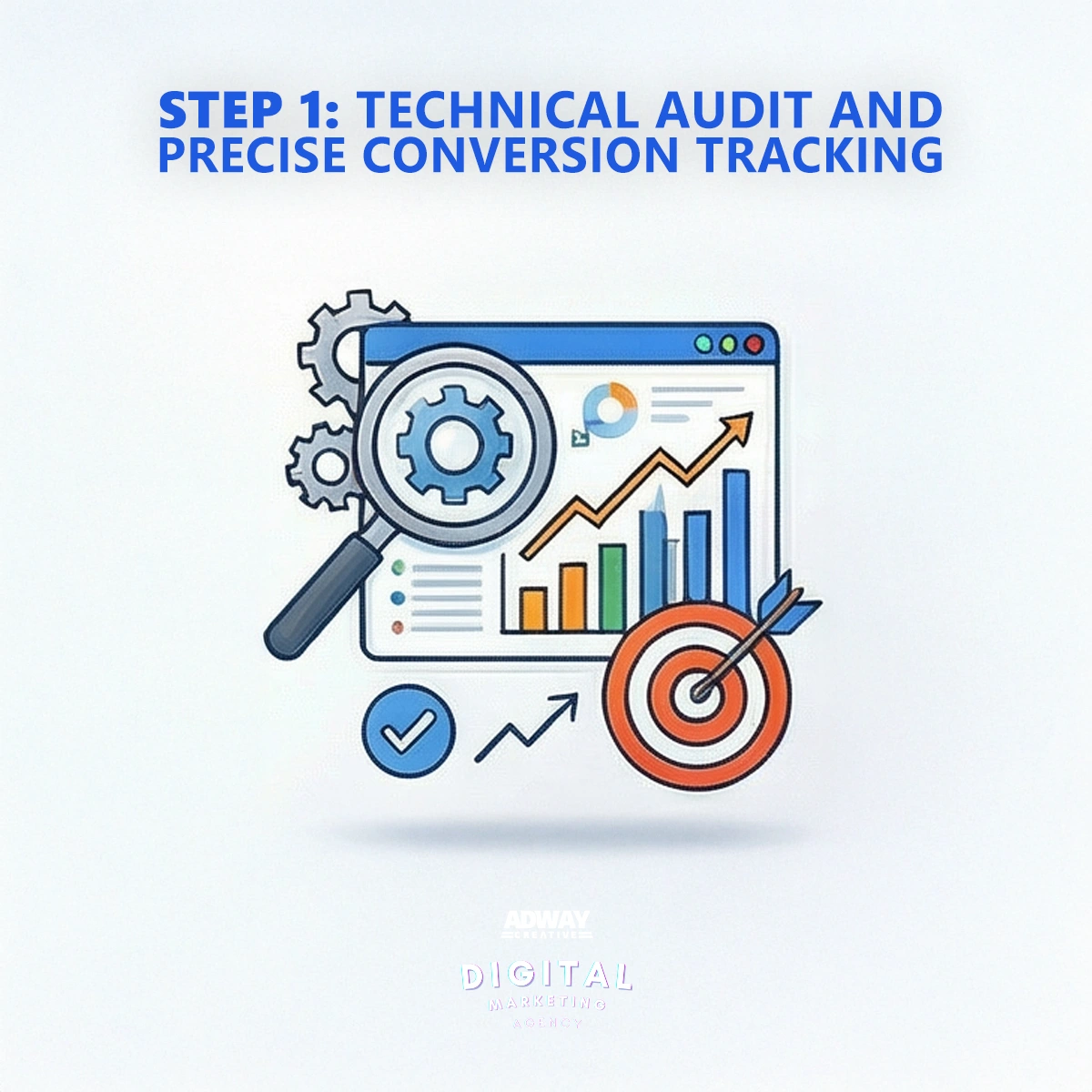
Step 1: Technical Audit and Precise Conversion Tracking
What We Do
Everything starts with data. Before we launch any Google Ads campaign, we ensure that we have a flawless tracking system in place. This includes setting up Google Analytics 4, integrating it with Google Tag Manager, and clearly defining goals (conversions) – whether it is a completed purchase, a submitted inquiry form, a phone call, or a file download.
Why It Saves You Money
Without measurement, every dollar is spent “blindly.” You pay for clicks but do not know which ones lead to paying customers. With precise tracking, we invest the budget only in those keywords, ads, and audiences that have a clear and measurable return on investment (ROI). In 2026, where AI-driven campaigns like Performance Max rely entirely on conversion data, this step is no longer optional – it is absolutely mandatory.
From Our Practice (Case Study – Rosela AD)
“With precise tracking for cucumber producer Rosela AD, we achieved a cost of 0.24 BGN per conversion and generated over 5,800 inquiries. This data would have been completely invisible without the correct technical setup from the very beginning.” View the full case study here.
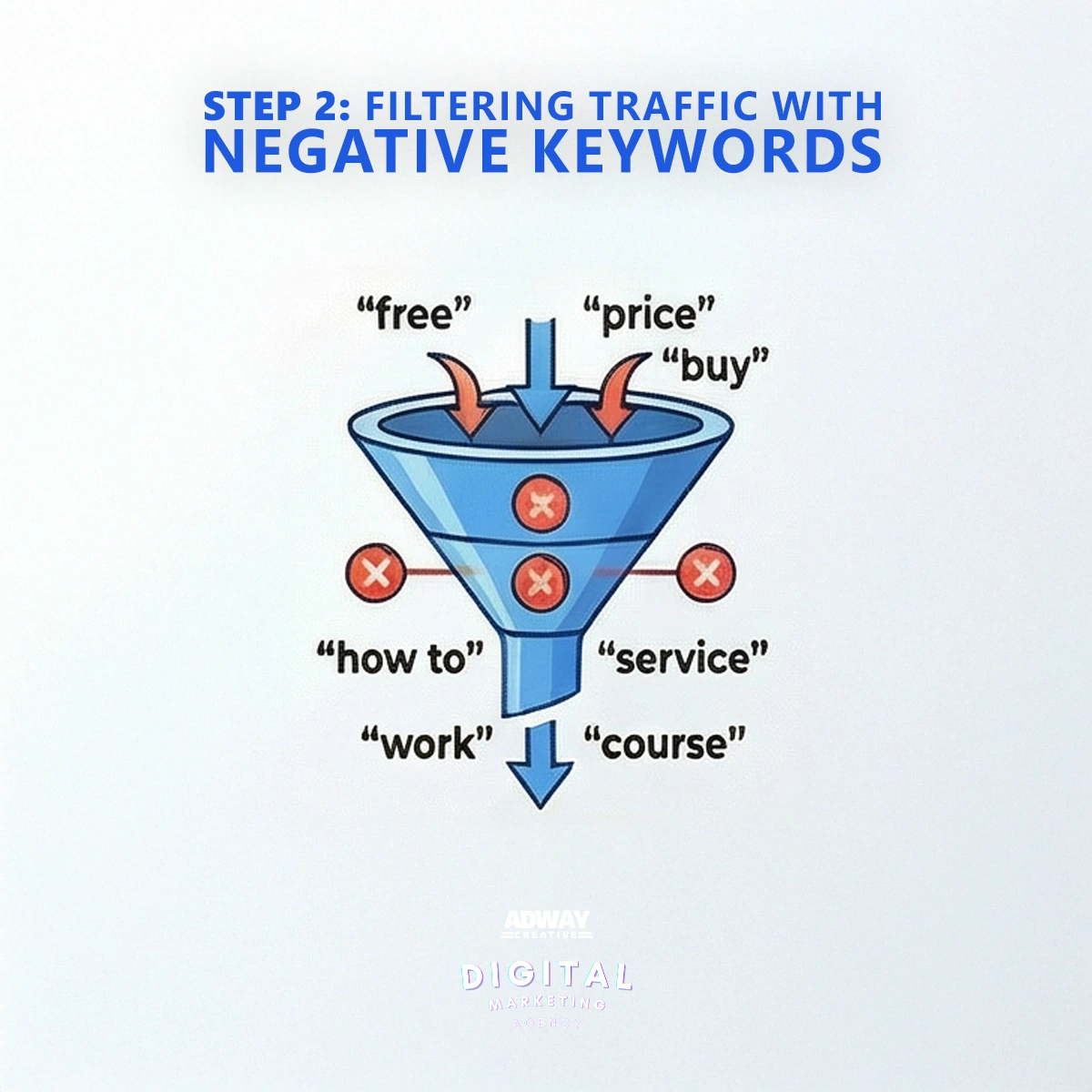
Step 2: Filtering Traffic with Negative Keywords
What We Do
We compile comprehensive lists of negative keywords – terms for which we do not want our ads to appear. These are search terms like “free,” “reviews,” “forum,” “how to make,” “second hand,” as well as the names of your direct competitors (unless the strategy dictates otherwise).
Why It Saves You Money
This is the fastest and most effective way to stop budget leaks from irrelevant traffic. By doing this, we eliminate clicks from people who are only searching for information rather than a solution, or simply comparing prices without any intention of purchasing.
Real-World Example
“When auditing new accounts we take over, we almost always find that up to 30% of the budget for the past month has been spent on completely irrelevant searches. I remember a B2B client who spent over 500 BGN on searches containing the word ‘internship’ (stazh) because they offered training-related services. Blocking these keywords has an immediate impact on the cost per conversion.”
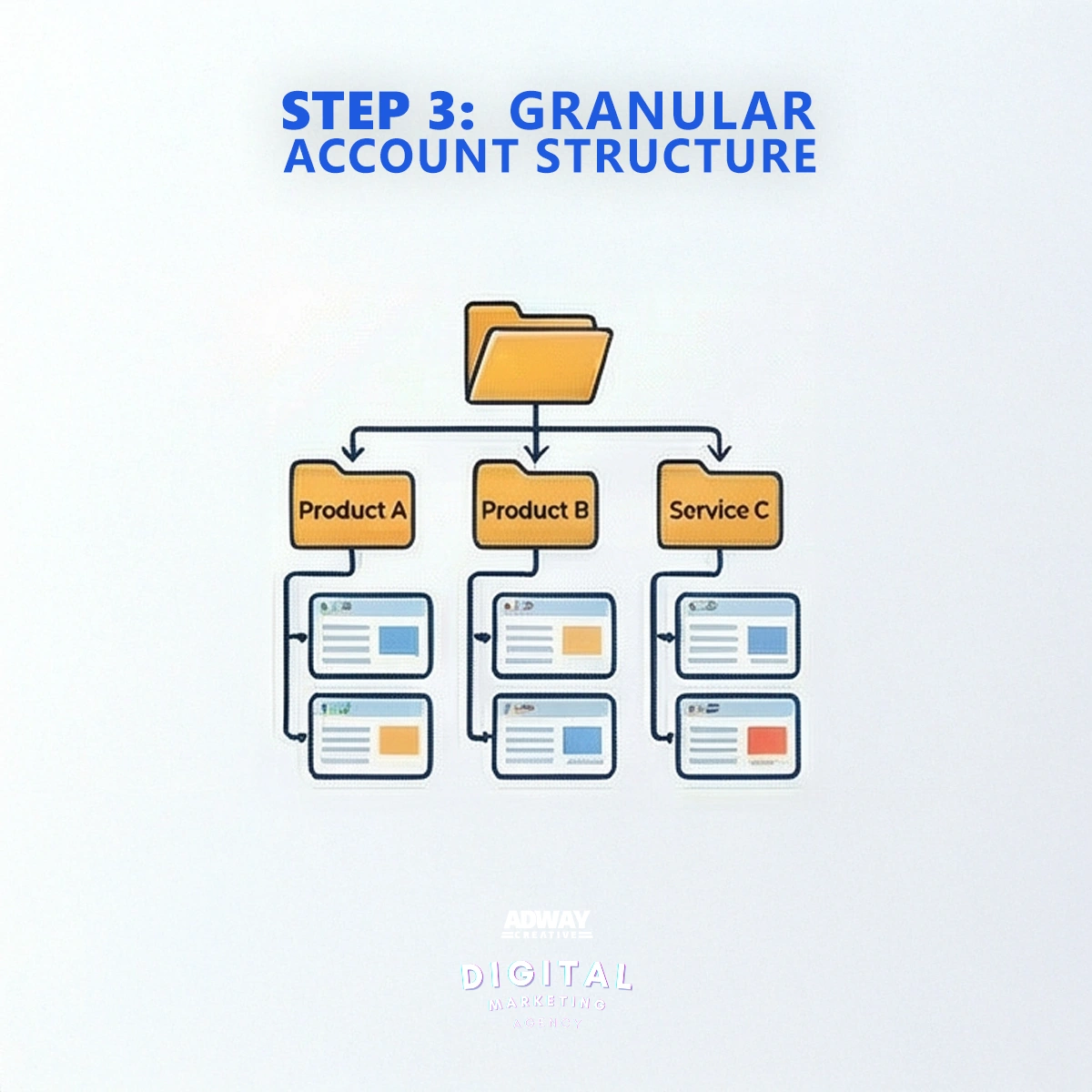
Step 3: Granular Account Structure for Maximum Relevance
What We Do
We avoid the “everything in one campaign” approach. Instead, we segment services or product categories into separate, tightly focused campaigns and ad groups. For example, instead of one general campaign for “legal services,” we create separate campaigns for “commercial law,” “family law,” “criminal defense,” etc.
Why It Saves You Money
Google rewards relevance. The tighter the link between the keyword, the ad copy, and the content on the landing page, the higher your Quality Score. A higher Quality Score directly leads to a lower cost-per-click (CPC) and better ad positioning. This means you pay less than your competitors for the exact same ad slot.
From Our Practice (Case Study – S&V Law)
“For Slavchev & Vasilev Law Firm, we didn’t just launch a general ‘lawyer’ ad. We segmented campaigns by legal services and languages (Bulgarian and English). This granular structure allowed us to achieve a CPC of just 0.67 BGN in a hyper-competitive niche where clicks often exceed several leva.” Explore the project here.
Step 4: User Experience (UX) and Landing Page Analysis

What We Do
We “step into the client’s shoes.” Before we invest a single cent in traffic, we thoroughly test the website:
- Loading Speed: Does the page load in under 3 seconds?
- Mobile Optimization: Is the site easy to use on a smartphone? Are buttons easy to find?
- Contact Forms: Do they function correctly? How many fields need to be filled out?
- Clear Call to Action (CTA): Does the user immediately understand what action to take?
Why It Saves You Money
There is absolutely no point in paying for expensive traffic to a site that cannot convert visitors into customers. By fixing the “leaks” in the user experience, we increase the conversion rate from the same number of visitors and the same budget.
“We have literally had to stop a client’s newly launched campaigns after discovering that the contact form on their mobile site was not sending messages. This saved them hundreds of leva in wasted clicks in just a few days. First we fix the ‘bucket’, then we turn on the ‘faucet’.”
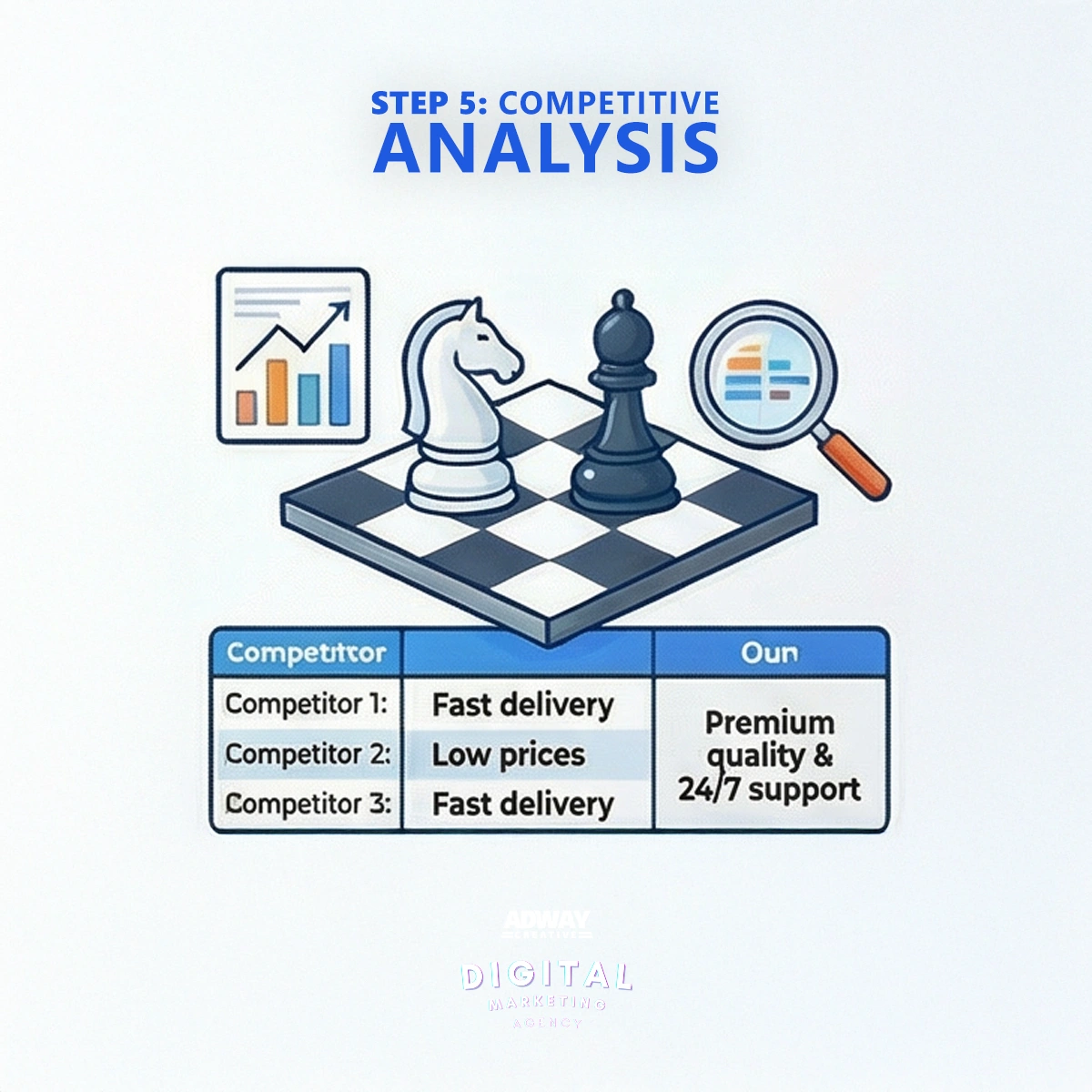
Step 5: Competitor Analysis for Stronger Messaging
What We Do
We use specialized tools to “spy” on what your competitors are doing in Google Ads. We analyze their offers, promotions, ad copy, and the unique selling propositions (USPs) they highlight.
Why It Saves You Money
Instead of competing solely on price or repeating clichés, we find your “gap” in the market. We discover what sets you apart and turn it into the core of your advertising messaging. This attracts the right customers and protects you from price wars that erode your profit margins.
“If all your competitors write ‘Quality services’ in their ads, it is a meaningless message. We find concrete advantages they don’t have – for example, ‘The only ones with ISO:9001 certification’, ’24-hour delivery in Sofia’, or ’25 years of industry experience’ – and turn them into your primary weapon in ad copy.”
Step 6: A/B Testing of Ad Copy and Visuals
What We Do
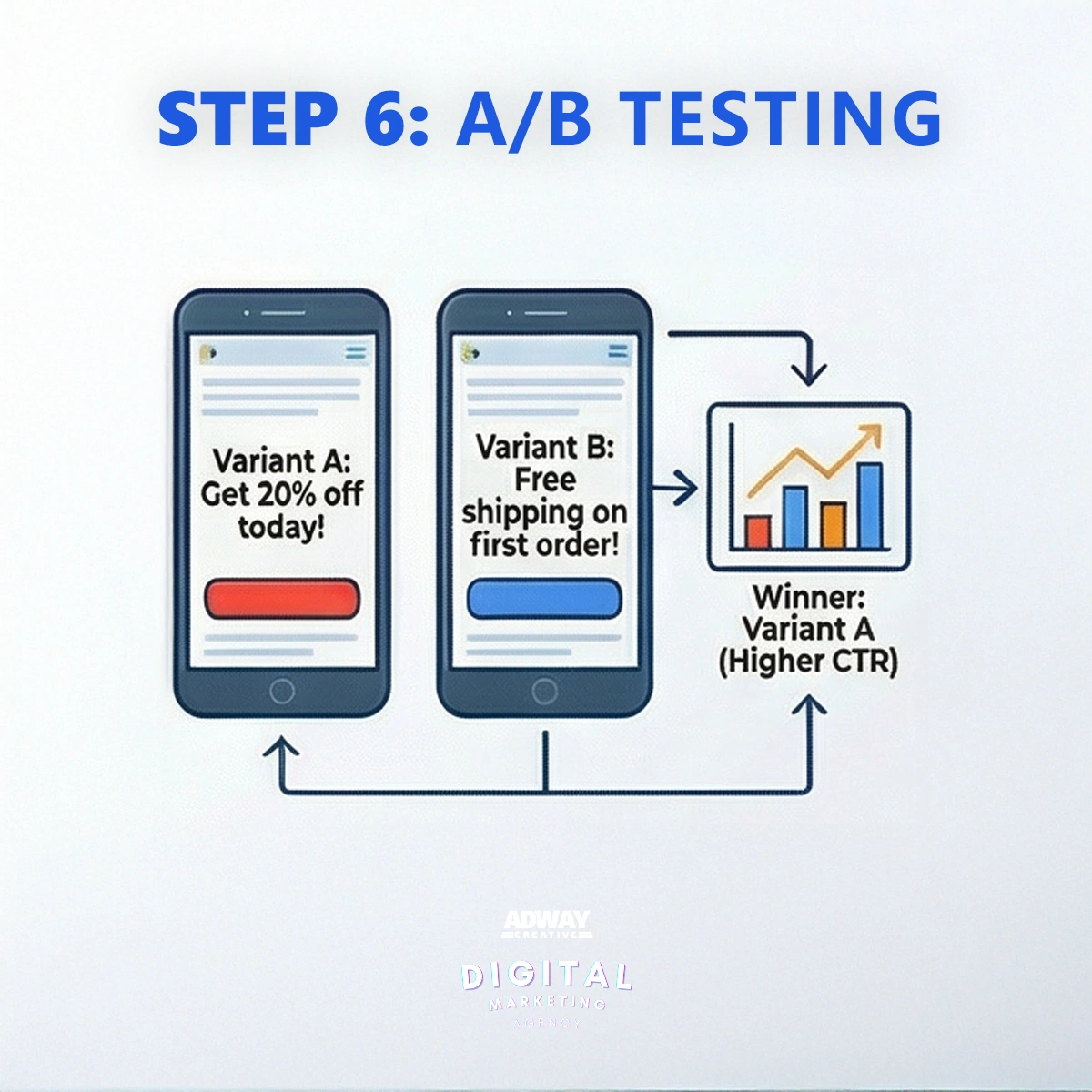
We never rely on assumptions. For each ad group, we create multiple variations of headlines and descriptions (for Responsive Search Ads) or different visuals and videos (for Performance Max campaigns). Then, we let Google’s algorithm show us which combinations perform best.
Why It Saves You Money
We do not guess which message will appeal to the audience. We let data show which text or image generates the most conversions at the lowest cost. In this way, we eliminate the subjective factor and gradually optimize campaigns to achieve maximum budget efficiency.
From Our Practice (Case Study – Arlet K)
“For Arlet K. Training Center, we tested different visual formats and messages in their Performance Max campaigns. Through continuous, data-driven optimization of creatives, we achieved a Click-Through Rate (CTR) of 7.16% – multiple times higher than the educational industry average.” Learn more about the campaign here.
Step 7: Realistic Budget and Goal Forecasting
What We Do
We use tools like Google Keyword Planner and our experience from dozens of accounts in various niches to give a realistic forecast of what can be achieved with a specific budget. We honestly discuss the expected cost-per-click, potential traffic volume, and a realistic number of conversions.
Why It Saves You Money
We protect you from the most expensive mistake in marketing – investing in goals that are mathematically unachievable with a given budget. Transparency and clear expectations are at the base of every successful partnership. If we evaluate that your goals are unrealistic, we will be the first to tell you, before you spend a single dollar. This is a key element of our philosophy for building trust.
Conclusion: Preparation Is the Key to a Successful Google Ads Campaign
As you can see, effective Google Ads advertising starts long before you hit the “Publish” button. Each of these seven steps acts as a safety net that catches potential budget leaks and channels your investment only into what brings results. If you are reviewing agency proposals, check whether tracking, landing-page checks and launch preparation are included. Use this Google Ads proposal comparison guide to clarify the scope before committing.
Skipping even one of them means leaving the door wide open for inefficient spending. By following this proven process, we at AdwayCreative ensure that the foundation of your campaigns is solid, measurable, and ready for success.
Ready to stop wasting money and start winning customers with Google Ads? Contact us for a free account audit and strategic consultation.
- About the Author
- Latest Articles
- Client Results

With more than fifteen years of hands-on experience in PPC, SEO, content marketing and social media, Iliya Avramov has built deep expertise in combining performance marketing strategy with modern digital systems. As founder of AdwayCreative, he works across Google Ads, Meta Ads, technical SEO, conversion-focused websites and growth frameworks for startups, B2B companies, service businesses and eCommerce brands.
His work is focused on practical, measurable outcomes: stronger lead quality, cleaner tracking, better conversion paths and campaigns that connect advertising spend to business value. Iliya has managed marketing budgets from $1,000 to more than $100,000 per month and has supported campaigns across industries including agriculture, healthcare, education, retail, professional services and international eCommerce.
He works with tools and data sources such as Google Analytics, Google Ads, Meta Ads, Search Console, SEMrush, Ahrefs and AI-assisted analysis. His approach follows current best practices from resources such as Google Search Central and Think with Google, while grounding recommendations in real campaign data and client results.
His leadership has helped AdwayCreative earn multiple industry recognitions, including:
2020: 3D visualization and graphic design recognition (Acquisition International).
2021: Media innovator recognition (Corporate Vision).
2022: Martech recognition (Corporate Vision).
2022: Global Finance recognition (Global Banking & Finance).
2023: Global Finance recognition (Global Banking & Finance).
2023: Full-service marketing and advertising agency recognition (Innovation in Business).
2024: Highly reviewed social media marketing agency in Bulgaria (The Manifest / Clutch).
2025: Customer satisfaction recognition in advertising and marketing (Global Banking & Finance).
Author disclosure: Iliya Avramov is the founder of AdwayCreative and may reference agency services in his content. Opinions and recommendations are based on professional experience, campaign data and independent research, with no hidden sponsorships.