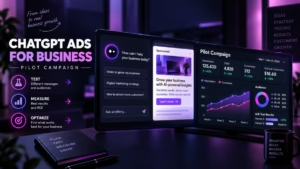
Updated: September 21, 2026
The key points at a glance
- ChatGPT Ads is now a real advertising channel, but that does not make it an automatic fit for every business.
- The technical minimum for EUR billing is €15/day, but this is a platform floor — not enough by itself to guarantee a useful business test.
- A good pilot begins with one clear hypothesis and one meaningful conversion goal, such as a qualified lead, purchase or booked consultation.
- Impressions, CTR and low CPC can show delivery and engagement, but they do not prove profitable customer acquisition.
- For B2B, it may be worth testing a softer research-oriented CTA — a comparison, calculator, guide or useful resource — instead of forcing every user directly into “Book a demo”.
- Tracking, landing-page quality and CRO need to be ready before the first paid click.
- At AdwayCreative, we treat ChatGPT Ads as a controlled pilot channel that needs to prove its economics before it earns more budget.
Should your business test ChatGPT Ads in 2026?
A ChatGPT Ads pilot is most interesting when your customers normally research, compare and ask questions before buying — and when you can reliably measure what happens after the click.
That is a more useful question than:
“Is this the newest platform?”
or:
“Are competitors already advertising there?”
Novelty is not a marketing strategy.
ChatGPT Ads can be interesting for businesses where buyers research options, ask for explanations, compare alternatives, estimate cost or risk and only then make a decision.
If you first need the mechanics — context hints, oCPC/oCPM, Product Feeds and current European limitations — read our guide to ChatGPT advertising in 2026.
But once you understand the platform, the more important question becomes:
Is there a strong enough business hypothesis to justify real budget?
When is a business a good candidate for a pilot?
We would not use a checklist that says “ChatGPT Ads is for everyone.” A better approach is to evaluate whether the conditions for a useful experiment exist.
| Situation | How we view it |
|---|---|
| Customers compare solutions and ask many questions | Strong signal for a test |
| You know the approximate value of a lead or sale | Makes CPA/ROAS evaluation possible |
| Your site already converts traffic from other channels | Reduces the risk of blaming ads for a landing-page problem |
| You have Pixel/CAPI, analytics and a lead-quality process | Close to essential |
| You run ecommerce with a structured product catalogue | Product Feed campaigns may be relevant |
| Your audience is highly professional/B2B and may over-index on paid ChatGPT plans | Requires more caution because paid plans are ad-free |
| You do not yet have reliable tracking, a functioning site or a clear offer | Fix the foundation first |
| You only want to “try €15/day and see” without a conversion goal | Not enough of a testing methodology |
This is not an automatic scoring system.
It is a way to decide whether you have a sufficiently clear hypothesis to test.
Why run a pilot instead of simply “launching ChatGPT Ads”?
The platform is evolving rapidly and independent performance data remains limited and mixed.
Our review of the first real-world ChatGPT Ads tests includes campaigns with hundreds of clicks and no qualified outcomes, alongside published positive examples.
That is why the right starting framework is an experiment.
What does a real pilot look like?
- one specific business hypothesis;
- one primary conversion goal;
- a capped, pre-approved budget;
- separate context hypotheses instead of mixing everything into one ad group;
- genuinely different messages or offers;
- Pixel/CAPI and analytics working before launch;
- pre-defined stop/scale rules;
- comparison with the economics of existing acquisition channels.
The goal is not to prove that the new platform is exciting.
The goal is to collect enough evidence to make a decision.
How much budget do you need for a ChatGPT Ads pilot?
At the time of our latest verification, the technical campaign minimum for EUR billing is €15/day.
At a constant €15 daily budget, that is roughly €450 over 30 days. But this only illustrates the scale of the platform minimum — it is not our recommended pilot budget.
Why?
Because if clicks in your category cost several euros, €15/day may produce only a small amount of traffic and almost no conversion data.
In another category, the same budget may produce far more observations.
A useful pilot budget therefore depends on:
- the business question being tested;
- the value of the conversion;
- expected traffic cost;
- the amount of data required to make a decision;
- the amount of risk the business is willing to accept for the experiment.
Technical minimum ≠ sufficient test budget ≠ profitable economics.
Publishing a universal “recommended budget” before understanding the hypothesis would create false precision.
Which conversion goal should you choose?
The best KPI is the one closest to genuine business value that can still be measured reliably.
For ecommerce, that is often a purchase.
For B2B, it may be:
- qualified enquiry;
- booked consultation;
- demo request;
- activated trial;
- registration that is later qualified;
- a downstream CRM stage in a longer sales cycle.
Problems begin when success is defined only as:
- impressions;
- clicks;
- CTR;
- cheap CPC;
- additional traffic.
Those metrics can help diagnose delivery, but they do not answer:
Was the investment worth it?
Tracking must be ready before the campaign
ChatGPT Ads now supports conversion-optimised campaign models, but the system cannot optimise reliably toward a business result you do not measure.
A sensible measurement framework may include:
- OpenAI Measurement Pixel and/or Conversions API;
- GA4 or another independent analytics system;
- consistent UTM parameters;
- CRM or another process for checking lead quality;
- a clear definition of what counts as a “qualified” lead.
That does not mean the business owner needs to understand event_id, oppref or CAPI payloads.
What do you need to know as the client?
You do not need to know what a CAPI payload looks like.
You need to answer three questions:
- Which action actually creates value for the business?
- What is a new customer or sale approximately worth?
- How will we know whether a lead from the campaign is genuinely qualified?
The technical implementation is the responsibility of the team building the measurement system.
The most interesting hypothesis: help the research process
Many B2B campaigns default to:
“Book a demo.”
That works in some contexts, but it can be too large a step for a person who is still researching the problem.
The early public evidence is not strong enough to claim a universal rule, but there is a useful hypothesis worth testing:
ChatGPT Ads may have a stronger chance when the ad helps the user continue their research rather than immediately asking for the final conversion.
Possible offers include:
- comparison guide;
- calculator;
- checklist;
- case study;
- benchmark;
- webinar;
- product selector;
- interactive configurator;
- useful resource that logically continues the conversation.
This is particularly relevant when the user is already asking detailed questions and comparing different approaches.
The ad does not necessarily need to close the sale in one click.
It may first need to win the next sensible step.
Do not send expensive traffic to a weak landing page
No advertising platform can automatically repair a website that:
- loads slowly;
- fails to explain the offer;
- lacks trust signals;
- uses an unnecessarily difficult form;
- performs poorly on mobile;
- promises one thing in the ad and shows something different after the click.
That is why we evaluate the campaign together with CRO.
If Google Ads and Meta Ads already drive relevant traffic but the site converts poorly, a new source of traffic is unlikely to fix the underlying problem.
Before buying more attention, we need to know whether the attention you already have becomes business.
Which stop rules should be defined before launch?
One of the most expensive mistakes in a new channel is continuing indefinitely because “we need more data.”
Before the pilot begins, we should know what would make us:
Continue
For example:
- the first qualified conversions appear;
- lead quality is comparable with existing channels;
- landing-page engagement shows meaningful intent;
- one context hypothesis produces materially stronger downstream behaviour.
Change the test
For example:
- there are clicks but almost no meaningful engagement;
- users engage but the CTA appears too aggressive;
- one ad group attracts irrelevant traffic;
- the landing page loses users at one identifiable step.
Stop
For example:
- enough traffic has accumulated but no downstream signal appears;
- lead quality remains consistently weak;
- the maths suggests CPA cannot reasonably reach an acceptable level;
- the test is taking budget away from a proven, more productive opportunity.
A stop rule is not pessimism.
It means the decision process was defined before emotion and sunk cost entered the conversation.
ChatGPT Ads should not be evaluated in isolation
Different channels can capture different moments in the customer journey.
| Channel | Role it may play |
|---|---|
| Google Search | Explicit search demand and strong search intent |
| Meta Ads | Discovery, creative-led demand and remarketing |
| ChatGPT Ads | Conversational research and consideration context |
| GEO / AI visibility | Organic discovery, citation and recommendation in AI answers |
These roles overlap, but they are not identical.
That is why the question should rarely be:
“Should we stop Google Ads and move the budget to ChatGPT?”
A better question is:
“Does ChatGPT add a profitable point in the customer journey that our existing channels do not cover well enough?”
Who should own the advertiser account?
The advertiser account should belong to the business itself.
The agency or external marketing team can be invited through the supported access workflow, while ownership remains with the advertiser.
This matters because country, billing currency and timezone are currently settings that cannot simply be changed after account creation.
The client should retain control over:
- advertiser account;
- billing;
- measurement assets;
- Pixel/CAPI setup;
- historical data.
We follow the same principle with other advertising platforms.
How would AdwayCreative structure a pilot?
At this stage, we position ChatGPT Ads as a pilot service, not as a channel where we promise a specific ROAS before seeing client data.
Our process would broadly follow this sequence:
- Diagnosis — audience, buying journey, offer, margin/lead value, website and tracking.
- Hypothesis — when and why a person using ChatGPT would have a reason to continue to the client’s offer.
- Measurement — Pixel/CAPI, analytics and downstream qualification.
- Pilot build — context hypotheses, message/creative and landing-page alignment.
- Controlled launch — capped budget and agreed stop/scale rules.
- Evaluation — qualified lead, purchase, CPA/CPL, ROAS and customer quality rather than CTR alone.
- Decision — scale, iterate or stop.
That may be a slower way to create an impressive presentation.
It is a faster way to find out whether the channel deserves the client’s money.
When would we tell you NOT to launch ChatGPT Ads?
Not launching a campaign can also be the correct marketing decision.
We would usually fix something else first when:
- tracking is missing or unreliable;
- the site clearly fails to convert;
- the product or service does not yet have a validated offer;
- there is no way to distinguish a good lead from a bad one;
- the budget is too small to answer any useful question;
- another high-intent opportunity is still severely underused;
- the main reason to launch is simply “everyone is talking about ChatGPT”.
There is no prize for being first in a channel that does not work for your economics.
There is value in being among the first to measure it correctly.
What counts as success?
Success does not mean:
“The campaign launched.”
It does not mean:
“CTR looked good.”
A well-designed pilot succeeds when it creates enough evidence for one of three decisions:
- Scale — economics and customer quality justify more budget;
- Iterate — there is a useful signal, but the offer, context or landing page needs improvement;
- Stop — the evidence does not justify further investment.
All three are useful outcomes from a properly designed experiment.
Want to know whether ChatGPT Ads is worth testing for your business?
You do not need to know how to configure context hints, Pixel, CAPI or conversion bidding.
You need a clear business objective and a reliable way to measure whether the investment produces a meaningful outcome.
We can assess your offer, audience, website and measurement setup and determine whether there is a strong enough hypothesis for a controlled ChatGPT Ads pilot.
Frequently asked questions about ChatGPT Ads pilot campaigns
What is the minimum budget for ChatGPT Ads?
At the time of our latest verification, the technical minimum for EUR billing is €15/day. This is the platform minimum, not a recommended budget for a reliable test.
How long should a pilot run?
There is no universal duration. The pilot needs enough data for the chosen conversion goal without continuing indefinitely when no useful signal appears.
Do we need to start with a Clicks campaign?
We do not treat that as a universal rule. The right campaign setup depends on available tracking, the conversion event and the actual objective of the experiment.
What needs to be set up before launch?
At minimum: reliable conversion measurement, a suitable landing page, analytics, UTM structure and a way to evaluate lead or purchase quality.
Is ChatGPT Ads suitable for B2B?
Potentially, especially for products and services with a longer research process. But part of the professional audience may use ad-free plans, so B2B fit should be tested rather than assumed.
Is it suitable for ecommerce?
Potentially yes, especially with a structured product catalogue. OpenAI supports Product Feed campaigns, but results still depend on offer, margin, product-market fit and measurement.
Should we stop Google Ads or Meta Ads?
Not simply because ChatGPT Ads is new. A new channel should first prove incremental business value compared with channels that already work.
When should the budget be increased?
Only after we see a sufficiently reliable downstream signal — qualified leads, purchases or another genuine business outcome — at acceptable economics.
Official sources
- OpenAI — Ads Manager Availability
- OpenAI — Create Campaigns for ChatGPT Ads
- OpenAI — Conversion-Optimized Campaigns
- OpenAI — Product Feed Campaigns
- OpenAI Developers — Measurement Pixel
- OpenAI Developers — Supported Events
- About the Author
- Latest Articles
- Client Results

With more than fifteen years of hands-on experience in PPC, SEO, content marketing and social media, Iliya Avramov has built deep expertise in combining performance marketing strategy with modern digital systems. As founder of AdwayCreative, he works across Google Ads, Meta Ads, technical SEO, conversion-focused websites and growth frameworks for startups, B2B companies, service businesses and eCommerce brands.
His work is focused on practical, measurable outcomes: stronger lead quality, cleaner tracking, better conversion paths and campaigns that connect advertising spend to business value. Iliya has managed marketing budgets from $1,000 to more than $100,000 per month and has supported campaigns across industries including agriculture, healthcare, education, retail, professional services and international eCommerce.
He works with tools and data sources such as Google Analytics, Google Ads, Meta Ads, Search Console, SEMrush, Ahrefs and AI-assisted analysis. His approach follows current best practices from resources such as Google Search Central and Think with Google, while grounding recommendations in real campaign data and client results.
His leadership has helped AdwayCreative earn multiple industry recognitions, including:
2020: 3D visualization and graphic design recognition (Acquisition International).
2021: Media innovator recognition (Corporate Vision).
2022: Martech recognition (Corporate Vision).
2022: Global Finance recognition (Global Banking & Finance).
2023: Global Finance recognition (Global Banking & Finance).
2023: Full-service marketing and advertising agency recognition (Innovation in Business).
2024: Highly reviewed social media marketing agency in Bulgaria (The Manifest / Clutch).
2025: Customer satisfaction recognition in advertising and marketing (Global Banking & Finance).
Author disclosure: Iliya Avramov is the founder of AdwayCreative and may reference agency services in his content. Opinions and recommendations are based on professional experience, campaign data and independent research, with no hidden sponsorships.