Updated: September 21, 2026
The key points at a glance
- Yes — as of the latest verification, Bulgaria is listed as “Available” for self-service OpenAI Ads Manager access.
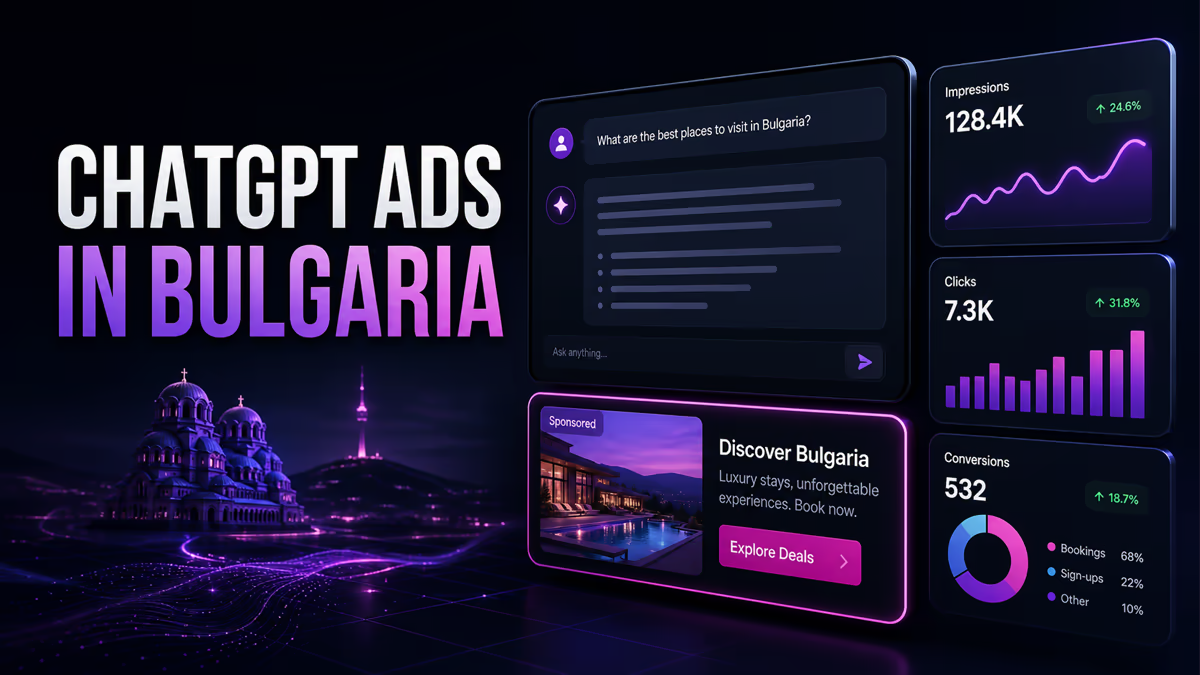
- ChatGPT Ads does not buy placement inside the AI-generated answer. Advertising is shown separately and clearly labelled as sponsored.
- Ads may be shown to users on Free and Go plans. Plus, Pro, Business, Enterprise and Edu remain ad-free.
- The platform supports CPM, CPC and conversion-optimised campaigns (oCPC and oCPM), as well as Product Feed campaigns for retail advertisers.
- One of the biggest differences from Google Ads is targeting: instead of traditional search keywords, the system evaluates conversational context and so-called context hints.
- Without accurate conversion tracking, a strong landing page and CRO, a cheap click has limited business value.
- AdwayCreative is preparing ChatGPT Ads as a controlled testing channel, not as a replacement for Google Ads or Meta Ads with a pre-promised ROI.
Is ChatGPT advertising already available in Bulgaria?
Yes. According to the latest official English OpenAI Ads Manager availability documentation, Bulgaria is listed as “Available” for self-service access.
This means that advertisers in Bulgaria can create an Ads Manager account and manage campaigns directly through the platform.
There is an important practical detail here.
During the rollout, translated Help Center pages may not always update at exactly the same time as the original English documentation. For that reason, we treat the current English OpenAI documentation as the primary source of truth for availability and platform functionality.
OpenAI has also announced that ChatGPT Ads is expanding rapidly across Europe and other regions, with a growing number of advertisers using the platform.
That tells us one thing clearly:
We are no longer discussing a theoretical future advertising format.
But it does not automatically prove that the channel will be profitable for every business.
What is ChatGPT Ads?
ChatGPT Ads is an advertising system that allows businesses to show paid offers in the context of conversations users are having with ChatGPT.
This does not mean that an advertiser can buy or influence the AI-generated answer.
OpenAI states that advertising is visually separated from the answer and clearly labelled as sponsored.
That distinction is critical.
If someone asks:
“Which CRM system would you recommend for a small sales team?”
ChatGPT may generate an independent answer.
A relevant sponsored placement may then appear separately below it.
A paid placement is therefore not the same as an organic recommendation from ChatGPT.
What does a ChatGPT ad look like?
According to the current platform documentation, a standard ad may contain:
- advertiser name;
- favicon or logo;
- short headline;
- description;
- landing page;
- image.
The placement appears separately from the AI response and is clearly marked as sponsored.
This creates an interesting creative challenge.
In Meta Ads, the creative often has to stop the scroll.
In Google Search, the ad needs to show immediate relevance to a specific query.
In ChatGPT, the user has already been having a conversation, explaining a problem and often clarifying what they need.
The ad therefore needs to feel less like an interruption and more like a logical next option.
Who can see ads in ChatGPT?
Advertising does not currently reach every ChatGPT user.
The current plan structure is:
| ChatGPT plan | Can ads appear? |
|---|---|
| Free | Yes |
| Go | Yes |
| Plus | No |
| Pro | No |
| Business | No |
| Enterprise | No |
| Edu | No |
Ads are also not shown to accounts identified as belonging to users under the age threshold defined by OpenAI.
This is one of the most important limitations when thinking about potential reach.
A headline such as:
“ChatGPT has more than one billion weekly users”
does not mean:
“An advertiser can reach more than one billion people with ads.”
A portion of the user base is on ad-free plans.
For certain B2B products this distinction may matter even more, because highly active professional users may be more likely to use paid ChatGPT plans.
That remains a hypothesis to test for each audience — not a universal rule.
Can advertisers read my ChatGPT conversations?
No.
OpenAI states that advertisers do not receive access to users’ conversations, chat history, memories, name, email, precise location, IP address or other private conversation data.
Advertisers receive aggregated advertising performance information such as impressions and clicks.
This does not mean conversational context is irrelevant to ad selection.
It can still be used inside ChatGPT to determine whether an ad is relevant.
The important privacy distinction is that the actual conversation is not handed over to the advertiser.
Are previous conversations used for ad targeting in Bulgaria?
There is an important European distinction.
OpenAI has stated that personalised advertising capabilities may differ in the European Economic Area and Switzerland.
Where broader ad personalisation is unavailable or disabled, advertising can still be selected using the current conversation, without relying on other conversations, ad history or broader personalised advertising signals.
For Bulgarian advertisers, this means we should not blindly copy US-based tutorials and assume every targeting feature works identically in Europe.
We need to evaluate the actual functionality available in the advertiser’s own Ads Manager account.
Custom Audiences: requirements and European (EEA) restrictions
ChatGPT Ads supports Custom Audiences, which allow advertisers to upload first-party customer or prospect records (email addresses, phone numbers — SHA-256 hashed, or Google Advertising IDs / GAID) for campaign-level inclusion or exclusion.
However, two strict criteria govern Custom Audiences:
- 25,000 matched user threshold: For audience inclusion targeting or audience bid adjustments, the uploaded list must match at least 25,000 active users on the platform (OpenAI recommends lists of 100,000+ matched users for optimal delivery). Audiences below 25,000 matched users may only be deployed for exclusions.
- EEA and Switzerland restriction: Because ad personalisation is not initially available across the European Economic Area (EEA) and Switzerland, OpenAI explicitly instructs advertisers targeting these jurisdictions to avoid using Custom Audiences.
For Bulgaria and other European markets, this confirms that ChatGPT ads deliver based on real-time conversational context (context hints) and location targeting, rather than user-level profiling and personalized custom segments seen in US tutorials.
How does ChatGPT decide which ad to show?
This is where the platform begins to differ fundamentally from traditional Search advertising.
OpenAI describes a combination of signals including:
- current conversational context and intent;
- landing page content;
- headline and ad copy;
- advertiser-provided context hints;
- campaign targeting settings;
- advertiser bid;
- additional signals where ad personalisation is available and permitted.
The system evaluates both relevance and bid.
That means the advertiser willing to pay the highest amount does not automatically win every placement.
What are context hints, and are they the same as keywords?
Context hints describe situations, needs and types of conversations in which an advertiser’s offer may be useful. They are not traditional exact-match search keywords.
OpenAI recommends keeping each ad group focused around a common product, user need or use case.
For example, instead of simply using:
“CRM software”
a useful context could describe something closer to:
“A small B2B sales team is looking for a simple CRM to track enquiries, opportunities and follow-up activity without implementing a complex enterprise platform.”
This represents a fundamental shift in how marketers need to think.
The question is no longer only:
What is the user searching for?
It also becomes:
What does the conversation look like while the user is trying to solve the problem?
What campaign objectives are available?
The current Ads Manager supports three main objective types.
| Objective | Billing model | Typical purpose |
|---|---|---|
| Reach | CPM | Visibility and brand impressions |
| Clicks | CPC | Traffic to a website or landing page |
| Conversions | oCPC or oCPM | Optimisation toward tracked post-click (oCPC) or post-click and post-view (oCPM) actions |
When selecting the Conversions objective, advertisers can choose between two delivery and billing models:
- oCPC (Optimised Cost-Per-Click): Billed strictly on valid clicks. The algorithmic delivery favors users who are statistically more likely to complete a conversion event after clicking the ad.
- oCPM (Optimised Cost-Per-Mille): Billed per 1,000 impressions. The delivery model optimizes toward conversions by factoring in a broader range of behavioral signals, capturing conversions that occur both after ad clicks and after ad views (post-view). This proves valuable for measuring conversions from users who notice a product in their chat conversation and convert later without an immediate click.
Importantly, under both models advertisers pay for clicks (oCPC) or impressions (oCPM), not per conversion. In addition, existing campaigns cannot change their objective or billing model once created.
Conversion-optimised campaigns strictly require active conversion tracking via the OpenAI Measurement Pixel and/or Conversions API (CAPI) with at least one supported standard event.
This explains why early advertiser accounts frequently displayed only Clicks: features are rolled out iteratively, and conversion objectives require a full measurement setup.
Product Feed campaigns for ecommerce
For ecommerce brands and product-driven retailers, ChatGPT Ads offers Product Feed campaigns. These allow the platform to integrate directly with structured product catalogs (uploaded via CSV/TXT, hosted HTTPS URLs, SFTP feeds, or automated Shopify store syncing).
Ads created from product feeds dynamically display live product images, titles, current pricing, and inventory availability. According to official statements from OpenAI, advertisers participating in the program who utilise product feeds are among the stronger performers. Products from feeds are eligible strictly for paid ad units during the beta and do not appear in organic ChatGPT conversational responses.
How much does advertising in ChatGPT cost?
There is no universal “ChatGPT advertising price”.
With CPC campaigns, advertisers set a maximum bid.
OpenAI publishes guidance for recommended starting bids, but this should not be confused with a guaranteed CPC.
The actual price paid can depend on:
- competition;
- relevance;
- available inventory;
- campaign configuration;
- auction dynamics.
Do not confuse bid, CPC and customer acquisition cost
A cheap click does not mean a cheap customer.
A campaign can generate low-cost traffic and zero sales.
Another campaign can have a higher CPC and still produce excellent ROAS.
For AdwayCreative, the real question will therefore not be:
“What does one ChatGPT click cost?”
but:
“What does a qualified conversion cost, and what business value does that conversion create?”
This is the same principle we apply when managing Google Ads campaigns and Meta Ads.
What minimum budget is needed?
According to current official OpenAI documentation, for ad accounts configured with EUR billing, the platform’s technical minimum daily campaign budget is €15/day (£15 for GBP, $25 for CAD and AUD). OpenAI specifies that the daily budget serves as a delivery target (meaning daily spend can fluctuate slightly), with spend over a rolling 7-day period capped at no more than 7 times the daily budget.
A vital strategic distinction: €15/day is the platform’s technical floor, not a guarantee that spending this amount will accumulate sufficient statistical data to make a sound business decision. We explicitly advise against treating €15/day as a recommended benchmark for a successful commercial campaign.
A realistic testing budget always depends on your industry niche, prevailing CPCs, conversational search volume, the number of conversion events needed for statistical relevance, and your ultimate commercial objective.
Our core strategic principle remains:
A test budget must be substantial enough to rigorously test a specific business hypothesis, but strictly bounded so experimental spend never jeopardises proven, profitable budgets in Google Ads or Meta Ads.
What should a good ChatGPT ad say?
The current platform guidance favours clear, specific, benefit-driven communication.
A generic message such as:
“We are your innovative partner for growth.”
communicates very little.
A more useful message would be:
“Google Ads management for B2B companies generating traffic but too few qualified enquiries.”
The user should understand immediately:
- what is being offered;
- who it is for;
- which problem it solves;
- why it may be relevant in that moment.
OpenAI also encourages genuine creative variation rather than producing many nearly identical ads.
Does ChatGPT advertising require a special landing page?
Not necessarily a separate URL, but the page must logically continue the promise made by the conversation and the ad.
The landing page also plays a role in how the system evaluates advertising relevance.
This makes CRO especially important.
If the ad is relevant but the page:
- does not answer the problem quickly;
- loads slowly;
- has an unclear CTA;
- performs poorly on mobile;
- asks for too much information;
- or fails to establish trust,
ChatGPT Ads may generate the click without generating the customer.
How are ChatGPT Ads conversions tracked?
OpenAI provides its own Measurement Pixel and Conversions API (CAPI).
The Measurement Pixel is a browser-side SDK that can register actions taken on a website after traffic arrives from ChatGPT Ads.
Conversions API can send conversion events from the server side.
Supported events can represent different stages of the customer journey.
This means conversion tracking should be part of the campaign setup — not something added weeks after launch.
For websites where we have technical deployment access, Pixel and CAPI can be implemented directly.
For custom websites owned or maintained by an external development team, we first define a safe deployment workflow.
We do not place server-side secrets in frontend code, and we do not make production changes without authorised access.
ChatGPT Ads vs Google Ads: are we buying the same intent?
No.
Google Search usually starts with an explicit search query.
ChatGPT begins with a conversation and broader context.
For example:
Google:
“accounting firm Sofia”
ChatGPT:
“I run a small company with two employees and EU clients. My current accountant never explains VAT procedures clearly. What should I look for when choosing a new accounting firm?”
The second example contains far richer context.
At the same time, the advertiser receives less direct visibility into the exact conversational path that led to the placement.
That is why we would not automatically replace a proven Search campaign with ChatGPT Ads.
The more sensible approach is to treat ChatGPT as an additional test channel around research and consideration.
ChatGPT Ads vs Meta Ads
Meta Ads often reaches people based on combinations of:
- audiences;
- interests;
- behaviour;
- first-party data;
- algorithmic signals.
ChatGPT Ads has a different potential advantage:
the moment in which the user is describing the problem in words.
In Meta, the creative may need to generate interest.
In ChatGPT, interest often already exists.
But this does not automatically mean the user has stronger purchase intent.
The conversation may be:
- educational;
- exploratory;
- comparative;
- or simply driven by curiosity.
Are ChatGPT Ads and GEO the same thing?
No. This distinction is critical.
With ChatGPT Ads, the advertiser pays for a sponsored placement.
With Generative Engine Optimization (GEO), the goal is to help AI systems discover, understand, cite or recommend the brand organically.
You can buy advertising space.
You cannot buy ChatGPT’s independent answer.
That is why the future strategy for many businesses is unlikely to be:
“GEO or ChatGPT Ads?”
It is more likely to become:
organic AI visibility + paid visibility + a strong website + accurate measurement.
This follows the same logic behind the AdwayCreative Growth Framework — channels become more valuable when they operate as one connected system.
Which businesses would we test ChatGPT Ads for first?
At this stage, we would assess each case individually.
Potentially interesting candidates may include businesses where customers typically:
- research before purchasing;
- compare several options;
- ask many questions;
- need explanation before making a decision;
- are trying to solve a clearly defined problem;
- generate enough value per sale or lead to justify experimentation;
- already have a website capable of converting traffic.
But we would never assume an industry will work simply because it sounds logically suited to ChatGPT.
We test the hypothesis.
What do we still not know?
The platform is developing too quickly for early observations to be treated as permanent rules.
There is still not enough independent public evidence to establish reliable universal benchmarks for:
- conversion rate;
- CPA;
- ROAS;
- B2B vs B2C performance;
- individual industries;
- mature oCPC performance;
- Bulgarian audiences;
- long-term auction behaviour as advertiser competition increases.
That is why we remain particularly cautious about claims such as:
“ChatGPT Ads generates customers X times cheaper.”
There is currently not enough evidence to defend that statement as a universal rule.
Who should own the ChatGPT Ads account?
A frequent operational question when adopting any emerging advertising channel is account ownership structure:
The advertiser account must always be registered by and remain the exclusive property of the business itself.
- Account ownership: OpenAI supports business advertiser accounts directly. The platform does not currently support an agency creating and holding an advertiser account on behalf of a client as the account owner. The business must register its own advertiser profile.
- Agency access: Once the client has established their account, the agency partner is invited to manage campaigns via Ads Manager’s multi-user access workflow.
- Permanent setup settings: Advertisers must configure initial settings with great care: country, billing currency, and timezone cannot be changed after account creation.
Does AdwayCreative offer ChatGPT Ads management?
We are preparing the service and the methodology for our first controlled client tests.
At the time of writing, we do not yet have a published proprietary ChatGPT Ads case study, and we will not present results from other agencies as our own.
What we already have is the transferable marketing infrastructure required to evaluate a new paid channel properly:
- PPC strategy;
- conversion tracking;
- Google and Meta advertising;
- landing pages;
- CRO;
- analytics;
- creative testing;
- GEO and AI visibility.
Our objective will not be merely:
“Launch ads in ChatGPT.”
We need to understand:
who clicked → what happened after the click → did the user become a qualified lead or sale → was the result economically better than the alternatives?
That is also the logic behind our 360° digital strategy.
What do the first real-world tests show?
Public results are currently mixed.
Some advertisers have generated inexpensive clicks but zero conversions.
Other agencies report significant volumes of qualified B2B leads.
OpenAI itself has already highlighted advertiser examples with strong ROAS.
We have separated that evidence into a dedicated analysis of the first real-world ChatGPT Ads tests.
Want to know whether ChatGPT Ads is worth testing for your business?
Rather than promising results from a new advertising channel in advance, we can first evaluate your audience, offer, website, measurement setup and existing acquisition channels.
If the test has a reasonable economic hypothesis, we can design a controlled campaign and judge it against real business outcomes — not only clicks.
Frequently asked questions about ChatGPT advertising
Is ChatGPT advertising available in Bulgaria?
Yes. According to the latest official OpenAI Ads Manager availability documentation, Bulgaria is listed as available for self-service access.
Can advertisers read my ChatGPT conversations?
No. Advertisers do not receive access to private chats, history, memories or personal conversation data.
Can advertising influence ChatGPT’s answer?
No. Sponsored placements are separated from the generated response. Advertisers do not pay to control ChatGPT’s answer.
Do all ChatGPT users see advertising?
No. Free and Go users may see ads. Plus, Pro, Business, Enterprise and Edu plans are ad-free.
Does ChatGPT Ads use keywords?
Not in the traditional Google Search Ads sense. The system evaluates conversation context, advertiser-provided context hints and other relevance signals.
Can ChatGPT Ads optimise for purchases and leads?
Yes. The platform provides conversion-optimised campaigns with two distinct billing models: oCPC (Optimised CPC) to optimise delivery toward post-click conversions, and oCPM (Optimised CPM) to factor in a wider array of signals (including post-click and post-view conversions). Both models require proper conversion tracking via the OpenAI Measurement Pixel or Conversions API.
Is the OpenAI Measurement Pixel required?
For basic traffic analysis, standard analytics and UTM tracking may still be useful. For reliable conversion measurement and conversion-focused optimisation, the OpenAI Pixel and/or Conversions API becomes an important part of the setup.
Is ChatGPT Ads better than Google Ads?
There is not enough evidence for a universal answer. The channels capture different moments in the customer journey and should be compared using CPA, lead quality and actual business value.
Does ChatGPT Ads replace GEO?
No. Sponsored advertising and organic inclusion in AI-generated answers are fundamentally different.
Does AdwayCreative already have a ChatGPT Ads case study?
Not yet. Our first campaigns will be treated as controlled tests, and we will publish results only after we have enough proprietary data to support meaningful conclusions.
Official sources
- OpenAI — Ads Manager Availability
- OpenAI — Ads in ChatGPT
- OpenAI — Ads in ChatGPT: The Basics
- OpenAI — Create Campaigns for ChatGPT Ads
- OpenAI — Conversion-optimized Campaigns
- OpenAI — Product Feed Campaigns
- OpenAI — Custom Audiences
- OpenAI Developers — Measurement Pixel
- OpenAI Developers — Conversions API
- OpenAI Developers — Supported Events
- OpenAI — A milestone in expanding access to AI
- About the Author
- Latest Articles
- Client Results

With more than fifteen years of hands-on experience in PPC, SEO, content marketing and social media, Iliya Avramov has built deep expertise in combining performance marketing strategy with modern digital systems. As founder of AdwayCreative, he works across Google Ads, Meta Ads, technical SEO, conversion-focused websites and growth frameworks for startups, B2B companies, service businesses and eCommerce brands.
His work is focused on practical, measurable outcomes: stronger lead quality, cleaner tracking, better conversion paths and campaigns that connect advertising spend to business value. Iliya has managed marketing budgets from $1,000 to more than $100,000 per month and has supported campaigns across industries including agriculture, healthcare, education, retail, professional services and international eCommerce.
He works with tools and data sources such as Google Analytics, Google Ads, Meta Ads, Search Console, SEMrush, Ahrefs and AI-assisted analysis. His approach follows current best practices from resources such as Google Search Central and Think with Google, while grounding recommendations in real campaign data and client results.
His leadership has helped AdwayCreative earn multiple industry recognitions, including:
2020: 3D visualization and graphic design recognition (Acquisition International).
2021: Media innovator recognition (Corporate Vision).
2022: Martech recognition (Corporate Vision).
2022: Global Finance recognition (Global Banking & Finance).
2023: Global Finance recognition (Global Banking & Finance).
2023: Full-service marketing and advertising agency recognition (Innovation in Business).
2024: Highly reviewed social media marketing agency in Bulgaria (The Manifest / Clutch).
2025: Customer satisfaction recognition in advertising and marketing (Global Banking & Finance).
Author disclosure: Iliya Avramov is the founder of AdwayCreative and may reference agency services in his content. Opinions and recommendations are based on professional experience, campaign data and independent research, with no hidden sponsorships.