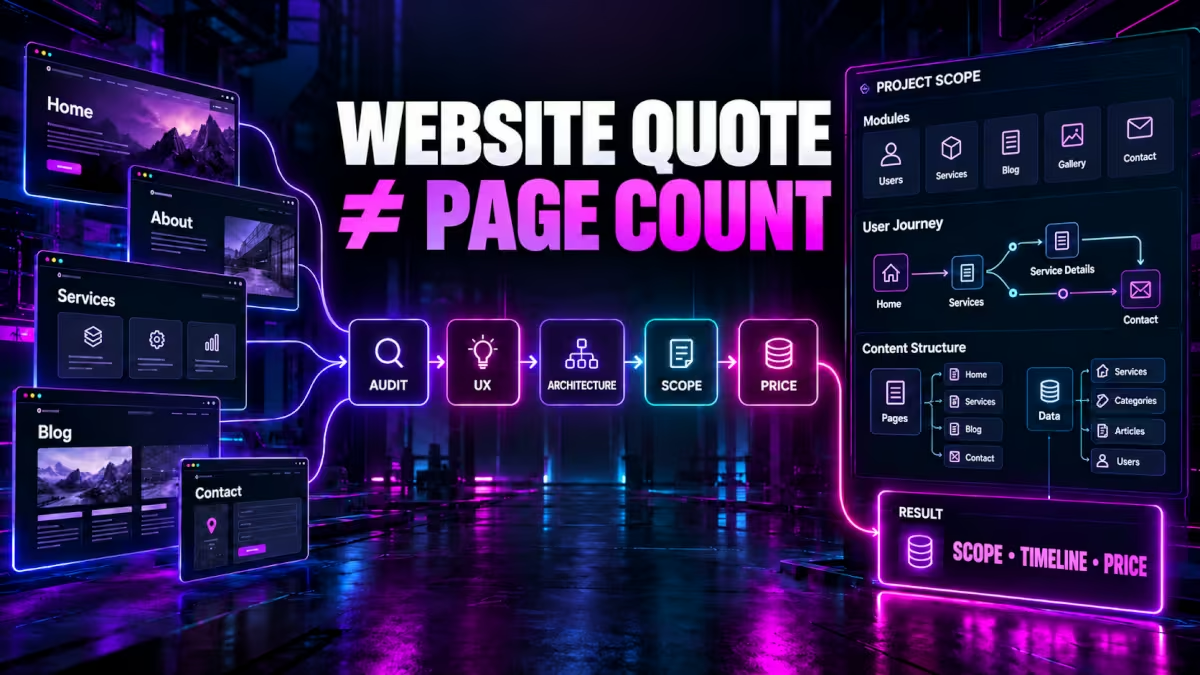
Key Takeaways
- A professional website development proposal should begin with the business problem the website needs to solve, not with a page count.
- “10 pages + WordPress + responsive design + contact form” describes a technical package. It does not necessarily describe the real scope of a specific business project.
- For an existing website, content, URLs, SEO, user journeys, administration and technical dependencies should be reviewed before the final timeline and price are defined.
- Good planning considers not only what visitors see, but also how the internal team will update prices, services, promotions, content, enquiries and orders.
- A predefined package can be perfectly suitable for a small, standard website. More complex projects require discovery before the scope can be priced reliably.
What Should a Website Development Proposal Start With?
It should start with the business problem and the way the website needs to work — not with whether the project will contain 8, 12 or 30 pages.
The page count is an outcome of the analysis. It is not the analysis itself.
When a client says, “We need a new website,” the underlying reason may be very different from one project to another:
- visitors cannot find the right service;
- the website receives traffic but generates few enquiries;
- pricing is difficult to find or understand;
- the same information has to be updated in several places;
- administration has become unnecessarily complicated;
- the mobile experience is poor;
- years of additions have created a confusing content structure;
- paid traffic is being sent to unsuitable landing pages;
- the business wants to introduce eCommerce but the current structure cannot support it;
- organic visibility needs to be preserved during a redesign.
So “we need a new website” is the beginning of the discovery process, not a technical specification.
For a professionally planned Website Development service, the first question is not how many pages need to be built.
It is:
What system does the business actually need, and what must that system achieve?
Why Is Page Count Not Enough to Price a Website?
Because two pages can look similar on the surface while requiring completely different amounts of work underneath.
A “Service” page may simply contain text and an image.
Or it may rely on structured data for:
- service variants;
- multiple prices;
- categories;
- problems the service addresses;
- areas or applications;
- related specialists;
- FAQs;
- video;
- related articles;
- current promotions;
- different calls to action for different users.
The same applies to apparently simple requirements such as “online payments”, “contact form”, “blog” or “site search”.
What Can Be Hidden Behind a Single Line in a Proposal?
| Short requirement | What may actually need to be defined |
|---|---|
| “Contact form” | Fields, context, recipients, spam protection, SMTP, success flow, thank-you page, tracking and failure handling |
| “Online payment” | What is purchased, variants, checkout, payment gateway, failed payments, refunds, partial refunds, emails and user roles |
| “Responsive website” | Navigation, sticky actions, touch targets, forms, tables, checkout, search/finder, readability and mobile performance |
| “SEO optimisation” | Search intent, URLs, taxonomy, internal links, schema, canonicals, sitemap, index/noindex rules and redirect mapping |
| “Blog” | Authors, categories, related content, update dates, FAQs, CTAs, sources and links to relevant services |
| “Promotions” | Start/end dates, promotional pricing, linked services, automatic expiry, archive behaviour and simultaneous campaigns |
Pricing therefore becomes meaningful only after we understand what the project actually includes.
For indicative budgets and common project types, see Website Development Cost 2026. This article focuses on a different question: how the project is defined before those numbers can be trusted.
How Should an Existing Website Be Analysed Before a New Proposal?
With a redesign, the first job should not be copying the old website into a more modern visual design.
The first job is understanding what already exists.
Depending on the project, an audit may include:
- existing URLs and page types;
- services, products and categories;
- blog content;
- menus and navigation;
- pricing structures;
- forms and conversion paths;
- mobile UX;
- internal search;
- checkout and customer accounts;
- the current CMS structure;
- technical dependencies;
- Search Console and organic visibility;
- analytics and real user behaviour;
- legacy advertising landing pages;
- duplicated or outdated content;
- backlinks pointing to URLs that may change.
The next step is content inventory.
For every important piece of content, a decision needs to be made:
Keep / Merge / Redirect / Retire.
A redesigned website should not simply reproduce the old information architecture with new colours.
That is why the Website Creation Process includes far more than visual design and development.
A User Journey Is Not the Same as a Sitemap
A sitemap tells us which pages exist.
A user journey tells us how a real person reaches a decision.
A sitemap might look like this:
Home → Services → Service X → Contact
But the actual journey may be:
Google → article about a problem → possible solutions → service → pricing → enquiry
Another visitor may arrive through paid search:
Google Ads → specific service → option → checkout → purchase
Another person may know the problem but not the name of the service.
Someone else may want a price immediately.
Another visitor may want to speak to someone before choosing anything.
That is why complex websites cannot always rely on navigation menus alone.
They may need search, a finder, filtering, problem-based navigation or other discovery mechanisms.
The Administrator Journey Has to Be Designed Too
This part is often invisible when businesses initially discuss a new website, but it determines how easy the system will be to manage for years after launch.
A properly planned website should answer questions such as:
- How is a new service added?
- Where is a price changed?
- How is a promotion created?
- How is a new service variation added?
- How is a specialist or author replaced?
- How are announcement start and end dates controlled?
- How is video added?
- How are orders processed?
- How are refunds managed?
- Where is SEO information edited?
The administrator should never have to ask: “Where else do I need to make the same change?”
Pricing is a good example.
There should be a clear source of truth. If the same price has to be entered manually in three different places, sooner or later those values will become inconsistent.
That is why the content model should be considered before visual design, with data separated from presentation wherever appropriate.
The same content can then be displayed through multiple components without being entered repeatedly.
This is one of the important distinctions between using a ready-made technical foundation and allowing a ready-made template to replace the analysis entirely.
For more context, see WordPress Template Website or Professional Website.
How Do eCommerce, Forms and Pricing Change the Real Project Scope?
“WooCommerce included” is not an eCommerce specification.
Before such a project can be estimated properly, we need to understand:
- what can actually be purchased;
- whether products or services have variants;
- whether physical shipping exists;
- how payment works;
- what happens when payment fails;
- how an order can be changed;
- when full or partial refunds are required;
- which customer emails are sent;
- which team members can manage orders.
And the process does not end when payment succeeds.
In a real business, a customer may need a different option, an additional payment, a partial refund or a later offline step.
Forms work in the same way.
“Contact form” does not tell us what context should be captured, who receives the enquiry, what the visitor sees after submission or how the business discovers that an email failed to arrive.
Those details may look small individually.
Together, they define the actual workflow.
SEO and Future Advertising Should Be Considered Before Development
SEO does not begin when an SEO plugin is installed after the website has already been built.
The architecture itself may need to account for:
- search intent;
- pillar and supporting pages;
- URL structure;
- taxonomy;
- internal linking;
- canonical logic;
- index/noindex rules;
- sitemap structure;
- structured data;
- old-to-new URL mapping.
This becomes particularly important during a redesign.
If pages with established organic visibility disappear without proper mapping and redirects, a visually improved website can still destroy an SEO asset that took years to build.
Future marketing also matters.
This does not mean that website development and Google Ads or Meta Ads management are the same service.
It means the website should be structurally ready for marketing when the business needs it.
Advertising may begin months after launch. But if the website was never designed for relevant landing pages, CTAs, thank-you flows, conversion points, forms and stable URLs, development often has to restart exactly when the business is ready to launch campaigns.
This applies to both Google Ads service and Meta Ads service.
It also reflects the logic behind the AdwayCreative Growth Framework: website, traffic, tracking and optimisation work better when they are treated as connected parts of the same growth system rather than isolated tasks.
A Real Example: How Large Can the Project Behind “We Need a New Website” Become?
In one of our recent redesign projects, the initial problem appeared straightforward: the existing website was difficult both to use and to manage.
Once we completed the inventory, the project turned out to contain around 80 core services, more than 70 problems and conditions, multiple areas, categories, promotions, dozens of articles and hundreds of existing URLs.
Those numbers are not a benchmark for every website.
They illustrate how different the real workload can be behind the same simple request: “We need a new website.”
Before the scope could be defined properly, we had to work through interconnected decisions such as:
- how users would discover the right service;
- how pricing would be managed;
- how promotions would work;
- how administrators could enter information once and reuse it;
- when the user should purchase and when they should send an enquiry;
- what should happen after payment;
- which URLs should remain;
- which URLs should be consolidated;
- how redirects should work;
- how the system could evolve without another rebuild two years later.
Only after those decisions does a detailed proposal begin to make sense.
Does This Mean Fixed Website Packages Are Bad?
No.
There are several perfectly valid ways to build websites.
For a small and standardised project, a predefined theme and a clear set of features may be a sensible solution. It can reduce both delivery time and cost.
The important question is whether the project actually fits the package.
| More standardised project | Project that usually needs deeper discovery |
|---|---|
| Small number of clearly defined services | Large or complex service/product catalogue |
| No significant legacy SEO migration | Hundreds of existing URLs |
| One straightforward form | Multiple enquiry flows |
| No complex eCommerce logic | Payments, variants, refunds and operational roles |
| Simple administration | Pricing, promotions and relationships between many content types |
| Few integrations | CRM, APIs, payment systems or other external dependencies |
The issue is not whether the website uses WordPress, Elementor, a ready-made theme or another foundation.
The issue begins when the technical foundation replaces the analysis and a predefined package is presented as a fully bespoke system without first checking whether it fits the business.
A related question is how to verify what was actually delivered after the project is finished. We cover that separately in “A Guy Built My Website”: How Do You Check What You Actually Received?.
How Long Does It Take to Prepare a Good Website Proposal?
There is no universal number.
A small website with straightforward content and standard functionality can often be estimated relatively quickly.
For an existing corporate website, a large service catalogue or an eCommerce project, however:
- discovery may require several discussions;
- inventory and auditing may take hours or days;
- existing content needs to be mapped;
- technical dependencies may only become visible during the review;
- architecture may change when new user or administrator scenarios are discovered.
For a complex project, preparing a reliable proposal can therefore require a substantial part of a working day or several days of analysis and discussion.
That is not wasted administrative time.
It is precisely what reduces the risk of hearing this halfway through the project:
“That wasn’t included in the original quote.”
What Should Be Clear Before Scope, Timeline and Price Are Finalised?
Before the final proposal, there should be enough clarity around:
- ☐ business goals and the core problem;
- ☐ user types;
- ☐ primary user journeys;
- ☐ administrator workflows;
- ☐ content model;
- ☐ information architecture;
- ☐ required functionality;
- ☐ mobile UX;
- ☐ search/finder logic where required;
- ☐ pricing architecture;
- ☐ eCommerce and post-purchase processes;
- ☐ forms and enquiry flows;
- ☐ legal/privacy requirements that need to be supplied or implemented;
- ☐ SEO architecture;
- ☐ migration and redirect logic;
- ☐ future advertising landing-page requirements;
- ☐ performance requirements;
- ☐ roles and permissions;
- ☐ technical integrations;
- ☐ content migration;
- ☐ QA scope;
- ☐ client and contractor responsibilities;
- ☐ hosting, licences, SaaS and other third-party costs;
- ☐ what post-launch support actually includes.
Only then can the project move reliably through:
scope → dependencies → timeline → price → exclusions
If the price is set before these questions are understood, it is usually the price of a predefined package rather than an estimate of the specific project.
And sometimes that is completely sufficient.
The important thing is that the client understands which of the two they are buying.
A Good Website Proposal Is Really the Result of Decisions Already Made
A client is not simply paying for a number of pages.
In a more complex project, much of the value comes from the decisions made before those pages are built: how information is structured, how people find it, how the internal team manages it, how results are measured and how the system remains usable as the business changes.
Once that work has been completed, the proposal is no longer an educated guess.
It becomes a description of an actual project.
Planning a New Website?
If you are planning a new website or a redesign, send us information about your business, the current website, the main problem and the result you want the new system to achieve.
We will start with what the website needs to solve, before deciding how many pages it needs.
Frequently Asked Questions About Website Development Proposals
Can a website be priced from the number of pages alone?
Sometimes, for a small standard website. For more complex projects, page count does not reveal functionality, content architecture, administration, SEO migration, integrations or QA requirements.
Why does an agency ask so many questions before providing a quote?
Because those questions define what actually needs to be built. Without discovery, important functionality may be excluded from the scope or appear later as unexpected additional work.
Am I paying only for design and development?
Not necessarily. Professional projects may also require business analysis, UX, architecture, content work, migration planning, SEO, tracking, QA and administration planning.
Does using a ready-made WordPress theme mean the website is unprofessional?
No. A ready-made theme or framework can be an excellent technical foundation. The important question is whether it has been adapted to the business rather than used as a substitute for proper analysis.
When is a fixed website package enough?
When the project is small, requirements are clear, functionality is standard and there is no complex migration, eCommerce logic or significant integration work.
Should SEO be discussed before development starts?
Yes. URL structure, taxonomy, internal linking, indexation and redirects can affect the website architecture itself, especially when redesigning an existing domain.
- About the Author
- Latest Articles
- Client Results

With more than fifteen years of hands-on experience in PPC, SEO, content marketing and social media, Iliya Avramov has built deep expertise in combining performance marketing strategy with modern digital systems. As founder of AdwayCreative, he works across Google Ads, Meta Ads, technical SEO, conversion-focused websites and growth frameworks for startups, B2B companies, service businesses and eCommerce brands.
His work is focused on practical, measurable outcomes: stronger lead quality, cleaner tracking, better conversion paths and campaigns that connect advertising spend to business value. Iliya has managed marketing budgets from $1,000 to more than $100,000 per month and has supported campaigns across industries including agriculture, healthcare, education, retail, professional services and international eCommerce.
He works with tools and data sources such as Google Analytics, Google Ads, Meta Ads, Search Console, SEMrush, Ahrefs and AI-assisted analysis. His approach follows current best practices from resources such as Google Search Central and Think with Google, while grounding recommendations in real campaign data and client results.
His leadership has helped AdwayCreative earn multiple industry recognitions, including:
2020: 3D visualization and graphic design recognition (Acquisition International).
2021: Media innovator recognition (Corporate Vision).
2022: Martech recognition (Corporate Vision).
2022: Global Finance recognition (Global Banking & Finance).
2023: Global Finance recognition (Global Banking & Finance).
2023: Full-service marketing and advertising agency recognition (Innovation in Business).
2024: Highly reviewed social media marketing agency in Bulgaria (The Manifest / Clutch).
2025: Customer satisfaction recognition in advertising and marketing (Global Banking & Finance).
Author disclosure: Iliya Avramov is the founder of AdwayCreative and may reference agency services in his content. Opinions and recommendations are based on professional experience, campaign data and independent research, with no hidden sponsorships.