TL;DR
- When you compare Google Ads agency proposals, similar promises can hide very different scopes. Setup, optimisation and reporting may appear in both proposals, but the work behind them can differ.
- The difference becomes clear when something goes wrong. Who checks inaccurate form conversions, broken tracking or a Google Ads policy restriction?
- Finding the problem is only part of the responsibility. Clarify who helps resolve it. Minor fixes may be included; larger technical, CRO or creative tasks should be discussed and, where needed, quoted separately, with approval before paid work begins.
- Regular communication helps connect reports to real business outcomes. Client feedback reveals which enquiries are relevant, what happens after the click and what needs to change in the campaign, website or offer.
- A lower price does not automatically mean worse service. Basic management may be enough for a straightforward campaign, a working website and reliable measurement. Compare the actual scope; broader support is valuable only when you need it.
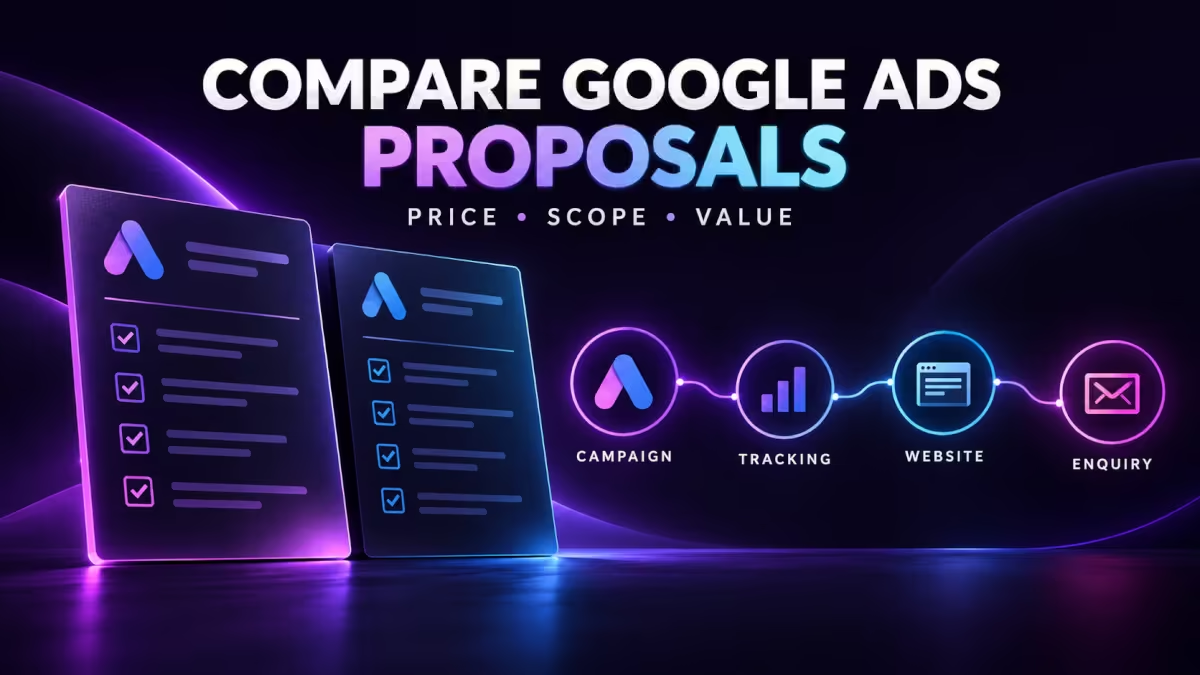
Two Google Ads proposals can both promise setup, optimisation and reporting while covering very different work. One may focus on campaigns alone; another may check tracking, review landing pages and coordinate technical fixes. The difference becomes clear when enquiries fall, a form stops working or advertising encounters a policy restriction.
The management fee alone does not tell you how much of the real problem the agency will take responsibility for. To compare Google Ads agency proposals fairly, establish what your business needs and what each supplier has committed to delivering.
What are you comparing beyond the management fee?
Start with: “What exactly does this proposal include, exclude and make the agency responsible for?” Separate initial setup, campaign build, ongoing management and advertising spend. Our guide to Google Ads management costs covers fees and media budgets; the decision here is whether the proposed scope fits your situation.
A focused campaign-management agreement can be sensible when your own team handles development, creative work and analytics. A wider engagement may help when those responsibilities are missing. Neither model is inherently better. Compare the gaps each proposal leaves, not simply the number of services listed.
A lower fee does not automatically mean worse service. A higher fee or broader scope does not automatically mean better value. The useful comparison combines price, responsibilities, evidence and the needs of your business.
Compare the agreed scope before comparing price
Ask each agency to clarify the same areas in writing. Terms such as “setup”, “optimisation” and “support” need a practical definition. Distinguish recommendations from implementation, and included work from an additional quotation.
| Criterion | What to clarify |
|---|---|
| Setup | Campaigns, markets, research and assets included |
| Tracking | GA4/GTM configuration, conversion definitions and testing |
| Optimisation | Search terms, bids, budgets, targeting and ad assets |
| Reporting | Business outcomes and lead-quality feedback |
| CRO and minor fixes | Analysis versus implementation; included corrections |
| Development | Separate scope, price and approval before work begins |
| Policy and technical support | Investigation and coordination outside the ad account |
| Communication and access | Contact, reviews, data ownership and handover |
For setup, check whether keyword intent, negative keywords, account structure, landing-page selection and testing are covered. Preparing a campaign before launch involves more than creating ads.
For ongoing work, ask how the agency identifies wasted spend and decides what to change. Search-term reviews, targeting, bids, budget allocation and ad testing are operational activities. Our guide to professional Google Ads account management explains that layer in more detail.
Treat tracking as a responsibility, not a checkbox
“Conversion tracking included” is incomplete unless you know what is counted and how it is tested. A click is a visit. An intent action, such as opening a form, indicates interest. A genuine enquiry confirms contact; a qualified lead also fits the service and buying criteria. A purchase or closed deal is a further business outcome.
These stages should not be presented as interchangeable. Ask who verifies completed actions, checks duplicates and investigates a mismatch between platform reports and your own records. Agree how your team provides lead-quality feedback: the agency cannot infer the outcome of every phone conversation from Google Ads.
Derma Vita: why the recorded action needs checking
In our work with Derma Vita Clinic, a particular period showed a gap between recorded actions and enquiries the client could confirm. Technical investigation identified issues around an older Divi form, its AJAX behaviour and the way actions triggered conversions. We reviewed the form behaviour and revised how a successful enquiry was confirmed.
This does not mean the earlier campaigns had never generated real enquiries. It means measurement needed attention during that period. When comparing proposals, ask who investigates such discrepancies instead of continuing to optimise against an unreliable signal. For reporting checks, see how to check whether the agency reports real business results.
Agree where landing-page and CRO responsibility ends
Ads can bring relevant visitors to a page that makes contacting the business difficult. Broken forms, unclear calls to action, mobile usability problems and friction in a booking flow can limit results even when the campaign is configured correctly. Ask whether the agency checks that path and who acts on its findings.
Small corrections may be included when agreed. A substantial redesign, custom feature, complex tracking rebuild, video or localisation project is a different commitment. The proposal should explain how such work is identified, scoped and quoted. Additional paid work should receive client approval before it starts. A website recommendation is not a promise of unlimited development.
CompanyRegistration.bg: campaigns and the website work together
The CompanyRegistration.bg Google Ads + CRO case study combines intent matching, negative keywords and clearer homepage messaging. The published campaign recorded 87 B2B enquiries from €664.70 in spend, at €7.66 CPA, with a 6.85% conversion rate and 8.36% CTR.
The comparison lesson is the scope of the work: filtering unsuitable traffic and improving how the page answers an investor’s questions. Those results are evidence from a particular campaign, not a forecast for another business.
Rosela AD: improvements beyond the advertising interface
For Rosela AD, our work included improvements to the Romanian website: a more visible ordering CTA, easier contact access, clearer product information and a contact/order widget. Video presentation and Romanian voice localisation also supported the wider conversion path.
The Rosela AD case study reports 5,830 conversions and a cost metric of 0.24 BGN per conversion in its campaign context. These figures should not be read as 5,830 qualified buyers or completed sales. The example shows why website and creative responsibilities need to be explicit in a proposal.
Ask who investigates policy and technical problems
An advertising problem may originate in destination content, website conditions, tracking architecture or a Google Ads policy requirement. Changing bids alone cannot resolve every cause. Ask whether policy investigation is covered and how the agency works with whoever controls the website.
Our CompanyRegistration experience includes restrictions linked to how Google classified the service. Depending on the issue, investigation may involve ad messaging, landing-page information, compliance clarifications, targeting or resubmission. This is not a guarantee that every restriction can be removed.
The useful criterion is not “Will you fix everything for free?” It is “Will you identify the cause, explain who owns the next step and coordinate a solution?” Agree which investigation is included and when external expertise or separately quoted work may be needed.
Make communication and approval part of the scope
Specify your contact, review frequency and how urgent issues are raised. Reporting should lead to decisions: what changed, what the business is seeing, what needs attention and what happens next. Agree what the agency can change independently and what requires approval, especially budgets and additional paid work.
Client conversations should cover lead relevance, common questions, sales follow-up, capacity and changing priorities. At AdwayCreative, active-account discussions are often weekly, depending on the project and agreed scope. Frequency alone is not the test; the conversation should produce useful feedback and clear actions.
When performance drops, clarify the process. Who checks tracking first? Who reviews traffic quality? Who tests the contact flow? Who explains the findings and proposes the next step? A named owner and agreed process are more useful than an undefined promise of “ongoing support”.
Clarify account and data access before signing
Establish which Google Ads account will be used, who has administrative access, who controls billing and how GA4 and GTM access is arranged. Confirm whether historical data and reporting remain accessible when the relationship ends. For detailed checks, read our guide to Google Ads account access and accountability.
Choose the scope your business actually needs
A lower-priced proposal may be sufficient for one straightforward Search campaign, one market, a usable landing page and reliable measurement, especially when an internal team handles website and creative work. Paying for additional services that solve no current problem is not better value.
Broader support may be appropriate for several markets, B2B lead generation, a complex conversion path, unreliable tracking or recurring technical and policy issues. Ask how each additional responsibility addresses a specific need. A longer proposal and a higher fee are not evidence of better execution.
The Park & Fly Sofia integrated case study illustrates a wider engagement involving advertising, website and booking UX, and local visibility. It reports 100,000+ new users and 17,000+ PPC conversions, described as reservations for 2020–2023. That scope should not be assumed to come with every Google Ads management agreement.
Check relevant evidence and independent reviews
Request a case that explains the starting problem, work delivered, measurement and period. A local booking business and a B2B service with a long sales cycle need different evidence. Compare the agency’s reasoning and responsibilities as well as the headline number.
Independent review sources provide another perspective on the relationship: Rosela AD’s review by Tzvetelina Bikoff on Clutch, and the separate reviews from Dr. Katya Paskova of Derma Vita Clinic and Miroslav Kozarov of Park & Fly on GoodFirms. Read reviews alongside the project context; they do not replace an agreed scope.
Questions to ask before accepting a proposal
- What exactly is included in setup and the monthly fee?
- Which campaigns, markets and assets are covered?
- Who configures and tests tracking, and who checks lead quality?
- Are landing-page problems identified, and are any minor fixes included?
- When does development require a separate quotation?
- Who investigates problems outside the ad account, including policy issues?
- Who communicates with us, and what reporting and review schedule is agreed?
- Who controls account access, billing and data at handover?
- How are additional costs and budget changes approved?
If the answers are materially similar, price is a reasonable deciding factor. If they differ, you are comparing different services. Resolve the gaps before signing so both sides understand the work, its limits and the basis for judging value.
Need help evaluating the right Google Ads setup for your business?
We can clarify your goals, campaign structure and the scope your business needs. Explore our Google Ads management service or discuss your project with us.
- About the Author
- Latest Articles
- Client Results

With more than fifteen years of hands-on experience in PPC, SEO, content marketing and social media, Iliya Avramov has built deep expertise in combining performance marketing strategy with modern digital systems. As founder of AdwayCreative, he works across Google Ads, Meta Ads, technical SEO, conversion-focused websites and growth frameworks for startups, B2B companies, service businesses and eCommerce brands.
His work is focused on practical, measurable outcomes: stronger lead quality, cleaner tracking, better conversion paths and campaigns that connect advertising spend to business value. Iliya has managed marketing budgets from $1,000 to more than $100,000 per month and has supported campaigns across industries including agriculture, healthcare, education, retail, professional services and international eCommerce.
He works with tools and data sources such as Google Analytics, Google Ads, Meta Ads, Search Console, SEMrush, Ahrefs and AI-assisted analysis. His approach follows current best practices from resources such as Google Search Central and Think with Google, while grounding recommendations in real campaign data and client results.
His leadership has helped AdwayCreative earn multiple industry recognitions, including:
2020: 3D visualization and graphic design recognition (Acquisition International).
2021: Media innovator recognition (Corporate Vision).
2022: Martech recognition (Corporate Vision).
2022: Global Finance recognition (Global Banking & Finance).
2023: Global Finance recognition (Global Banking & Finance).
2023: Full-service marketing and advertising agency recognition (Innovation in Business).
2024: Highly reviewed social media marketing agency in Bulgaria (The Manifest / Clutch).
2025: Customer satisfaction recognition in advertising and marketing (Global Banking & Finance).
Author disclosure: Iliya Avramov is the founder of AdwayCreative and may reference agency services in his content. Opinions and recommendations are based on professional experience, campaign data and independent research, with no hidden sponsorships.