TL;DR
- The website creation process in 2026 does not start with design. It starts with strategy: business goals, audience, structure, content, SEO, and technical foundations.
- The key steps are analysis, planning, UX structure, copy and content, design, development, SEO/GEO optimization, analytics setup, testing, launch, and ongoing support.
- The client does not have to write the whole website, search for every image, or invent the structure alone. The client provides business context; the agency turns it into a working web system.
- At AdwayCreative, we build websites with a clear message, mobile-first UX, SEO, AI visibility, speed, and real inquiries in mind.
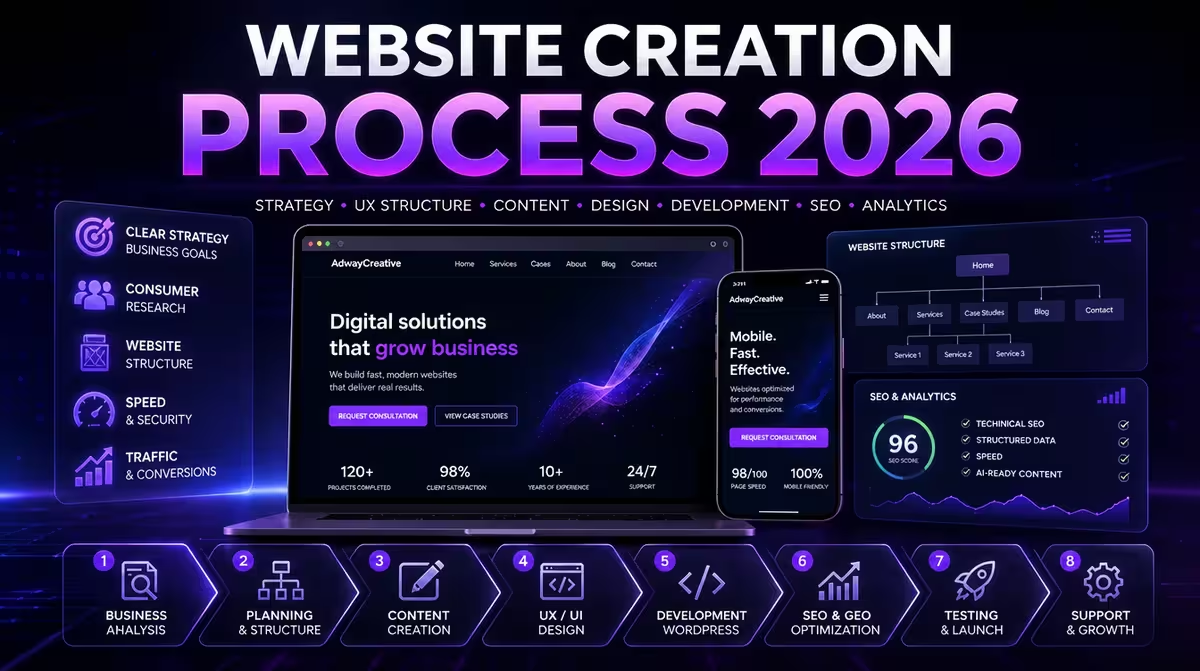
What are the main steps in building a website?
The main steps in building a website are business analysis, audience research, structure planning, content preparation, UX/UI design, development, SEO/GEO optimization, analytics setup, testing, launch, and ongoing support. If one of these steps is missing, the website may look finished but still fail to bring traffic, trust, or inquiries.
Many businesses think of a website as a design project. In reality, a modern website is a combination of strategy, content, technical foundations, and marketing logic. Design matters, but design alone does not solve the problem if the structure is chaotic, the copy is unclear, and the pages cannot be understood by Google and AI search systems.
As a professional website development agency in Sofia working with remote and international projects, we treat strategy, structure, and clear business logic as the starting point before the first design screen.
Why should a website not start with design?
Design is the visible part of the project, but it is not the starting point. If you begin directly with colors, sections, and visual effects, you risk ending up with a beautiful website that has no clear business logic.
Before design, it should be clear what the business sells, who the most important client is, what the user has to understand in the first seconds, which pages are needed for SEO, which questions potential customers ask, what the main goal is, and how the website will develop after launch.
Good website = clear strategy + correct structure + strong content + fast technical foundation.
Step 1: Business and goal analysis
The first step is understanding what job the website has to do. A website for a law firm, online store, clinic, manufacturer, or B2B service should not have the same structure.
In this phase, we clarify what services or products the business offers, which directions are most profitable, which clients matter most, what inquiries we want to receive, what objections users have, what differentiates the business, and whether the project needs Bulgarian, English, or multilingual versions.
This is not just a question of what appears in the menu. It is the business logic of the website. If this step is skipped, the result is often generic, visually pleasant, and unconvincing.
Step 2: Audience and search research
After business analysis comes research. This includes user intent and SEO logic.
It is important to understand how people search for the service, what words they use, what questions they ask before buying, what they compare, what concerns they have, what competitors already do, and where the content gaps are.
When creating a website in 2026, this research is no longer only about Google Search. More users ask questions directly inside AI systems such as ChatGPT, Gemini, Perplexity, and Google AI Overviews. A strong SEO and GEO structure starts here.
Step 3: Sitemap and website architecture
After analysis, we build the sitemap: the logical map of the website. This is where we decide which pages should exist and how they should connect to each other.
For a company website, this can include a homepage, main service page, separate service pages, about page, portfolio or case studies, FAQ section, contact section, blog or resource center, and required policy pages.
Every page needs a clear role. If a page does not serve the user, SEO structure, or conversion path, it probably does not need to exist.
Step 4: UX structure and user journey
UX structure defines how the user moves through the website. It answers a simple question: what does the person need to see in order to understand, trust, and take the next step?
Usually we plan the first screen and main message, navigation, trust sections, services and advantages, proof such as case studies or reviews, FAQ blocks, CTA buttons, contact forms, mobile version, and speed of comprehension.
This is often where conversion is decided. A well-structured website can sell better even with less traffic because the user understands the offer faster.
Step 5: Content, copy, and messaging
One of the most common mistakes in the website creation process is expecting the client to prepare all copy, images, sections, and messaging alone. A professional process should not work that way.
The client knows the business. The agency should help turn that business context into a clear web structure, readable copy, and persuasive presentation.
Usually we need basic information: what the business offers, which services or products matter most, who the ideal clients are, what questions customers ask, what the main advantages are, whether existing photos or materials are available, and whether there are legal or industry-specific requirements.
After that, the team can help with page structure, copy and editing, section ideas, image selection and optimization, icons, visual elements, CTA blocks, required policies, internal link logic, and SEO structure.
Important from AdwayCreative
The client should not have to be a copywriter, UX designer, and SEO specialist at the same time. The client’s role is to provide business context; our role is to turn it into a website that is clear, structured, and ready for traffic.
Step 6: UI design and visual identity
Once the structure is clear, design begins. The goal is not simply to make the website look modern. The goal is to support trust, readability, and conversion.
Good UI design guides attention, makes reading easier, highlights important messages, builds trust, works well on mobile devices, supports brand identity, does not hurt speed, and does not hide important information behind effects.
For a premium website, visual identity directly affects perceived quality. This is especially important for high-value services, B2B projects, medical services, legal services, real estate, manufacturers, consultants, and companies that need to look credible to partners.
Step 7: Website development
After design comes technical implementation. In a WordPress project, this can include Elementor, Gutenberg blocks, custom CSS, structure optimization, responsive settings, and integrations.
This phase builds the pages, menu, sections, forms, responsive views, technical settings, basic SEO structure, images, required policies, and connections between pages.
Good development is not only making the website match the design. It has to be stable, fast, easy to maintain, and ready for future growth.
Step 8: Mobile-first optimization
Most users will see the website on a phone. The mobile version should not be treated as a secondary thought.
With a mobile-first approach, we check whether the first screen is clear, buttons are easy to tap, texts are readable, the menu is understandable, forms are short and working, images are not too heavy, and no important element is hidden or broken on smaller screens.
Step 9: SEO and GEO foundations
SEO should not be attached after launch. The website has to be planned so users, Google, and AI search systems can understand the pages from the beginning.
This includes headings, clean URL logic, internal links, meta titles and descriptions, schema markup where appropriate, image SEO, FAQ sections, and clear answers that can be extracted by AI systems.
Step 10: Analytics, tracking, and conversion setup
A website should not launch without measurement. Analytics setup helps you understand where traffic comes from, which pages perform, and which actions generate real business value.
At minimum, the project should include GA4, Google Search Console, sitemap submission, tracking for forms and CTA clicks, consent configuration, and a clear plan for reading the data after launch.
Step 11: Technical optimization and security
Technical quality affects user experience, SEO, advertising efficiency, and maintenance. Speed, image optimization, caching, HTTPS, backups, plugin hygiene, and basic security checks should be handled before launch.
Step 12: QA and testing before launch
Before publishing, the website should be tested carefully. This includes links, forms, mobile and desktop layouts, speed, metadata, indexing settings, accessibility, spelling, and content.
This is where small mistakes are caught before they become expensive: a broken form, wrong link, heavy image, broken mobile menu, or missing meta description.
Step 13: Launch and first checks
Work does not end when the website is published. The first hours and days matter for technical verification.
After launch, we check whether all pages load, HTTPS works correctly, there are no broken links, the sitemap is accessible, Search Console accepts the site, forms send messages, analytics records visits, the mobile version is stable, cache works correctly, and images render as expected.
The website should not simply be uploaded. It should be launched under control.
Step 14: Support and growth after launch
A modern website is not a one-time file. It is an asset that should continue to develop.
After launch, most websites need technical updates, backups, security checks, new pages, blog content, SEO improvements, speed optimization, service updates, behavior analysis, and CTA or form improvements.
If the website is part of a wider digital strategy, the next layers are SEO, Google Ads advertising, social campaigns, content, video, and conversion optimization. This is why AdwayCreative treats the website not as an isolated online brochure, but as the center of the digital system. When the site has to support a full customer acquisition system, see our guide to 360-degree digital strategy.
What does a good website process look like?
| Stage | What happens | Why it matters |
|---|---|---|
| Analysis | Business goals, audience, offer | The website has clear direction |
| Structure | Sitemap, UX journey, pages | The user finds information easily |
| Content | Copy, images, policies | The website explains and persuades |
| Design | UI, mobile-first, trust | The brand looks professional |
| Development | WordPress, responsive, performance | The website works reliably |
| SEO/GEO | Headings, internal links, FAQ | Google and AI systems understand the content |
| Launch | QA, indexing, analytics | The site starts without critical gaps |
Common mistakes to avoid when creating a website
The most common mistakes are not only technical. Many begin during planning.
1. Starting from a template without strategy
A template can speed up the project, but if the structure does not fit the business, the result often looks like every other website.
2. Leaving copy until the end
Content is not filler. It is part of the sales process. If copy is added quickly at the end, the website almost always loses clarity.
3. Thinking only about desktop
The mobile version is often the main version for the user. If it is compromised, the whole website suffers.
4. Missing clear CTA elements
The user has to know what to do next: send an inquiry, call, view a service, request an offer, or book a consultation.
5. Missing SEO foundations
A website without structure, headings, metadata, and internal links can look ready but remain almost invisible.
6. No support after launch
WordPress, plugins, security, content, and technical optimization require care. Without support, the website gradually becomes outdated.
Does the website have to be made in Sofia?
AdwayCreative is a digital agency in Sofia, but works with clients across Bulgaria and on international projects. For some local businesses, live meetings can help with strategy and planning, but the real value comes from the process: analysis, structure, design, development, and optimization.
Most modern web projects can be delivered fully remotely without affecting quality, communication, or results.
If you are looking for a partner for website development in Sofia, the important question is whether the team understands business logic, SEO structure, user behavior, and the need for the website to grow as a digital asset. For indicative budgets, see our guide to website development cost.
What do you get from a professional website process?
Professional website creation should deliver more than a visual page. A well-built website should have clear structure, good mobile UX, a strong first impression, understandable copy, optimized images, technical SEO foundations, prepared CTA sections, analytics foundations, good speed, room for growth, and a logical connection with future marketing.
When the website is part of a wider strategy, it is also important to think about the relationship between SEO and Google Ads.
AdwayCreative takeaway
A website should not simply look good. It should explain quickly, build trust, load fast, be understandable for Google and AI search systems, and guide the user toward the next step.
Conclusion: How do you create a website that actually works?
Website creation in 2026 is a process that starts with strategy and ends with measurement, support, and growth. Design is only one part of the system.
If you want the website to create real value, do not start with “how should it look?” Start with what it has to achieve, who will use it, what the user has to understand, how it will be found in Google, how AI search systems will understand it, and how it will turn traffic into inquiries.
That is the difference between a website that simply exists and a website that works as a digital asset.
Planning a new website or redesign?
At AdwayCreative, we can help with strategy, structure, copy, images, UX/UI design, WordPress development, SEO/GEO foundations, and technical preparation for growth.
Frequently Asked Questions
What are the main steps in building a website?
The main steps are analysis, research, sitemap, UX structure, content, design, development, SEO/GEO optimization, analytics setup, testing, launch, and support.
How long does website creation take?
The timeline depends on scope. A landing page can be completed faster, while a corporate website, online store, or custom platform requires more planning, content, design, and QA.
Do we need to prepare all website copy in advance?
Not necessarily. The client should provide business context, services, advantages, and core information. The team can help with structure, copy, editing, images, CTA blocks, policies, and SEO logic.
Should SEO be done after the website or during development?
SEO should be planned during the structure stage. If it is added only after launch, pages, menus, headings, URLs, and content often need rework.
What is GEO in website creation?
GEO means optimization for AI search systems and generative answers. The goal is to structure the website so systems such as ChatGPT, Gemini, Perplexity, and Google AI Overviews can understand the content and use it as a reliable source.
Does every website need a blog?
Not always, but for businesses that depend on organic traffic, a blog can be an important part of the SEO and AI visibility strategy.
What matters most in the mobile version?
Readability, speed, easy navigation, visible CTA buttons, and working forms matter most. The mobile version should not be a compromised version of the desktop design.
Can the website grow after launch?
Yes. A well-built website should allow new pages, blog articles, languages, campaigns, landing pages, SEO improvements, and additional functionality.
For larger projects, we use the AdwayCreative Growth Framework to organize the website, content, tracking, and future traffic as one connected process.
Pro Tip for eCommerce growth: If you run an online store, separate services such as web development, traffic, and SEO should work as one system. See our solutions for digital marketing for online stores and request a free audit.
- About the Author
- Latest Articles
- Client Results

With more than fifteen years of hands-on experience in PPC, SEO, content marketing and social media, Iliya Avramov has built deep expertise in combining performance marketing strategy with modern digital systems. As founder of AdwayCreative, he works across Google Ads, Meta Ads, technical SEO, conversion-focused websites and growth frameworks for startups, B2B companies, service businesses and eCommerce brands.
His work is focused on practical, measurable outcomes: stronger lead quality, cleaner tracking, better conversion paths and campaigns that connect advertising spend to business value. Iliya has managed marketing budgets from $1,000 to more than $100,000 per month and has supported campaigns across industries including agriculture, healthcare, education, retail, professional services and international eCommerce.
He works with tools and data sources such as Google Analytics, Google Ads, Meta Ads, Search Console, SEMrush, Ahrefs and AI-assisted analysis. His approach follows current best practices from resources such as Google Search Central and Think with Google, while grounding recommendations in real campaign data and client results.
His leadership has helped AdwayCreative earn multiple industry recognitions, including:
2020: 3D visualization and graphic design recognition (Acquisition International).
2021: Media innovator recognition (Corporate Vision).
2022: Martech recognition (Corporate Vision).
2022: Global Finance recognition (Global Banking & Finance).
2023: Global Finance recognition (Global Banking & Finance).
2023: Full-service marketing and advertising agency recognition (Innovation in Business).
2024: Highly reviewed social media marketing agency in Bulgaria (The Manifest / Clutch).
2025: Customer satisfaction recognition in advertising and marketing (Global Banking & Finance).
Author disclosure: Iliya Avramov is the founder of AdwayCreative and may reference agency services in his content. Opinions and recommendations are based on professional experience, campaign data and independent research, with no hidden sponsorships.