Key Takeaways
- A cheap website is not necessarily a bad website. The risk begins when the low price hides an unclear scope, missing QA, unprepared tracking, and dependence on the contractor.
- The real cost is not just the first invoice. It includes rebuilding, wasted advertising budget, missed inquiries, migration, access recovery, and lost time.
- In 2026, a small professional corporate website typically starts at approximately EUR 900–1,200, but repairing a legacy project may add a technical audit, migration, new content, and measurement recovery.
- Sometimes a website can be repaired. In other cases, a redesign or complete rebuild costs less than endless partial fixes.
- The most important question is not “How cheaply can we start?” but “What will we own, and what will work when the project is complete?”
How Much Does a Cheap Website Really Cost When It Has to Be Rebuilt?
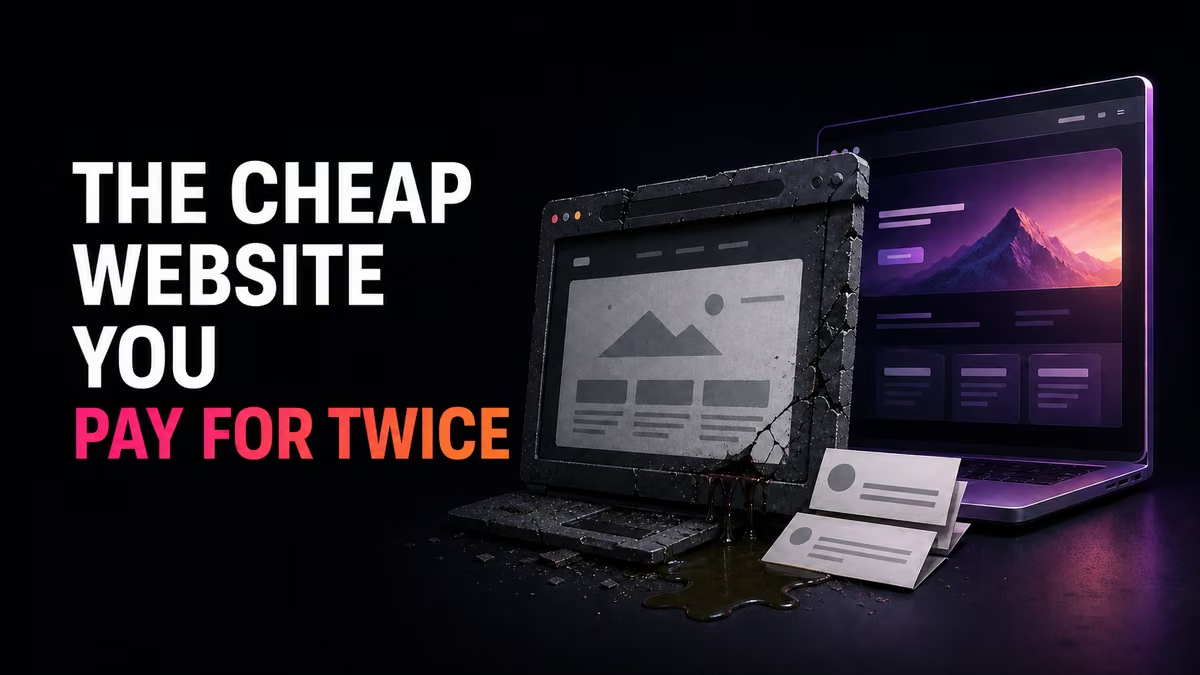
A cheap website can cost far more than the original quote once rebuilding, wasted advertising budget, missed customers, migration, new tracking, and time spent recovering access are added.
That is why the real project cost should not be measured only by the first invoice.
It should be measured as the full cost of creating, using, repairing, and maintaining the website as a business asset.
When comparing proposals, look beyond the initial amount and consider how to choose a digital partner without losing control of your business.
Real cost = first invoice + repeated work + wasted budget + missed customers + asset recovery
This formula explains why a service that looks cheapest at the beginning can become the most expensive decision six or twelve months later.
Does a Low Price Automatically Mean Low Quality?
No. A low price alone does not prove that a service is poor.
A ready-made WordPress theme, a small team, or a freelancer may be entirely appropriate when:
- the scope is described honestly;
- the client understands the limitations;
- the chosen technology is suitable;
- the website is tested;
- ownership and access are clear;
- additional services are not presented as included when they are not;
- the result supports the project’s real objective.
At the same time, a high price does not guarantee a professional result.
The issue is not whether the service is “cheap” or “expensive.” The issue is whether you can verify:
- exactly what was completed;
- why a particular approach was chosen;
- how the website was tested;
- who owns the accounts and licences;
- whether the forms and measurement work;
- what happens when the relationship ends;
- how much future development will cost.
A more detailed distinction between the technical foundation and genuinely professional work is available in our analysis of a WordPress template website versus a professional website.
Which Costs Accumulate When a Website Is Rebuilt?
The most common mistake is comparing only the price of the first website with the quote for the new one.
In reality, the second project usually begins with additional work that would not have been necessary if the original project had been planned correctly.
| Cost | How it arises | What you should check |
|---|---|---|
| Initial development | The amount paid for the first website | What was actually included |
| Technical audit | The new team must understand the structure, code, and dependencies | Whether access to the website, hosting, and database exists |
| Repairs or rebuilding | Parts of the project cannot be reused | What can be retained and what must be replaced |
| New content | The copy is weak, incomplete, or copied from the demo | Whether usable business information exists |
| Redesign and mobile UX | The structure or navigation does not work | Whether a cosmetic change or a new UX is required |
| SEO migration | URLs, metadata, and internal links must be transferred | Whether there are indexed pages and organic traffic |
| New tracking setup | Forms and meaningful actions are not measured | Whether GA4, GTM, and conversion events exist |
| Access recovery | The domain, hosting, or platforms are controlled by the contractor | Who is the owner and administrator |
| Licences and subscriptions | Third-party or unclear licences are being used | What stops working when the contractor changes |
| Wasted advertising budget | Campaigns lead to an unsuitable or broken website | Whether conversions and forms are valid |
| Missed inquiries | Visitors cannot understand the offer or make contact | How much traffic passed through without a measurable result |
| Management time | The owner coordinates disputes, repairs, and another handover | How many hours were taken away from the core business |
| Contractual and legal costs | There is a dispute about assets, content, or an unfulfilled scope | Whether a qualified lawyer should review the situation |
Not every legacy project includes all these costs.
However, the less clearly ownership, scope, and technical structure are documented, the more unknowns must be assessed before the new contractor can even begin.
How Do You Calculate the Full Cost of a Cheap Website?
Start with every resource that was actually paid for or lost, not only the design and development price.
A Working Total Cost of Ownership Formula
- Add the website’s initial price.
- Add all repairs and maintenance paid for so far.
- Add the advertising budget spent on pages that did not work.
- Add the cost of technical, SEO, and tracking audits.
- Add the cost of repairs, redesign, or rebuilding.
- Add migration, licence, and access-recovery costs.
- Estimate the time lost by the owner and team.
- Estimate the missed inquiries or sales.
- Add any contractual and legal costs.
The result is far closer to the real cost of the decision than the amount in the first quote.
Working Table
| Component | Your amount |
|---|---|
| Initial website | ___ EUR |
| Repairs and maintenance | ___ EUR |
| Advertising spend sent to broken pages | ___ EUR |
| Audit and diagnostics | ___ EUR |
| Redesign or rebuilding | ___ EUR |
| Migration and access recovery | ___ EUR |
| New content and visual materials | ___ EUR |
| New SEO and tracking setup | ___ EUR |
| Lost working time | ___ EUR |
| Other costs | ___ EUR |
| Full real cost | ___ EUR |
Lost revenue cannot always be calculated precisely. That does not mean it does not exist.
When reliable tracking is unavailable, use a range rather than a falsely precise figure.
How Much Does a Professional Website Rebuild Cost in 2026?
The final price depends on how much of the existing website can be retained safely.
As a guide, current public price ranges for new web projects in 2026 are:
| Project type | Indicative range |
|---|---|
| Product landing page | EUR 250–325 |
| Landing website with up to 8 sections | EUR 600–780 |
| Small corporate website with up to 8 pages | EUR 900–1,200 |
| Medium corporate website with 8–15 pages | EUR 1,600–2,100 |
| Online store | EUR 1,700–2,300 |
| Large corporate website with 16–20 pages | EUR 2,500–3,250 |
| Custom platform | From EUR 5,000 |
These amounts are guidelines for a new project, not an automatic price for recovering a legacy website.
Repeated work may additionally include:
- a technical audit;
- a backup and staging environment;
- content extraction and cleanup;
- domain or hosting transfer;
- an SEO migration map;
- redirects;
- analytics recovery;
- new conversion tracking;
- cookie-consent verification;
- replacement of unlicensed components;
- recreation of images;
- form and email-delivery testing.
Current ranges and the differences between project types are explained in detail in our guide to website development costs in 2026.
Repair, Redesign, or a Completely New Website?
Not every weak website should be deleted and rebuilt from scratch.
Before making a decision, distinguish between three different scenarios.
1. A Localised Repair
This is appropriate when:
- the technical foundation is stable;
- the client has all required access;
- the website has a logical structure;
- the problem affects a few specific components;
- the forms can be repaired;
- the mobile version has limited defects;
- the content is generally usable;
- the SEO structure does not require major changes.
Examples include:
- a broken contact form;
- a missing conversion event;
- a broken CTA link;
- several slow images;
- an incorrectly configured thank-you page.
2. Website Redesign
A redesign is more appropriate when the technical foundation can remain, but the user experience, content, and conversion logic need to be reworked.
It usually includes:
- a new page structure;
- improved navigation;
- a new primary message;
- revised copy;
- mobile-first UX;
- new CTA sections;
- clearer presentation of services;
- stronger trust signals;
- SEO and internal-linking changes;
- a new tracking plan.
The five main signs that this type of change is needed are covered in our website redesign guide.
3. Complete Rebuilding
A new website is usually the more sensible decision when:
- administrative control is missing;
- a reliable backup cannot be created;
- the code is unstable or unsupported;
- the structure copies an unsuitable demo;
- services cannot be organised logically;
- the mobile version requires almost complete reworking;
- there is no clear SEO architecture;
- the URL structure is chaotic;
- the website depends on third-party licences;
- there is no reliable tracking;
- every repair creates another problem;
- future development is severely restricted.
In these cases, endless small repairs can cost more than a controlled rebuild.
When Do Partial Repairs Begin to Cost More?
A partial repair makes sense when it resolves a specific problem.
It becomes wasteful when every repair:
- requires another temporary workaround;
- creates a conflict with another component;
- cannot be tested reliably;
- depends on the only person who understands the system;
- does not solve the underlying structural problem;
- does not improve measurement;
- does not make the website easier to maintain.
Do not keep repairing a technical foundation that cannot become a sustainable business asset.
Sometimes the cheapest decision is a small repair.
Sometimes the cheapest long-term decision is to stop paying for repairs.
How Does Advertising Increase the Hidden Cost of a Weak Website?
A website does not exist in isolation.
When paid traffic is directed to it, every unresolved problem begins costing money every day.
Advertising may lead to a page where:
- the service is not explained;
- the price or next step is unclear;
- the form does not work;
- the phone number is wrong;
- the mobile button is difficult to reach;
- there is no proof or trust;
- the page loads slowly;
- the conversion event records only a click rather than a real inquiry;
- the user encounters a different promise from the one made in the ad.
In this scenario, the business pays simultaneously for:
- the click;
- the missed opportunity;
- incorrect data;
- the future repair;
- collecting reliable information again.
The advertising platform may report a “conversion” while the real business receives no customer.
This is exactly why the website, advertising, and measurement must be treated as one system.
A Real Example: When Advertising Was Not the Only Problem
In a legacy project for a local cleaning company, we found a combination of problems:
- the website used a ready-made foundation without sufficient conversion logic;
- some of the content and visual presentation did not reflect the actual services;
- there was insufficient clarity around the advertising account;
- the advertising budget had started at approximately EUR 50 per day;
- on some days, spending reached approximately EUR 200;
- the client lacked sufficient visibility into what was being changed and why;
- when results were missing, the recommendation was to invest even more budget.
The problem could not be solved with a new advertising campaign alone.
We had to reorganise:
- the website;
- the services;
- the pricing information;
- the contact options;
- conversion tracking;
- the Google Ads structure;
- the analysis of genuine inquiries.
For Vasilevi Clean, we built a new conversion-focused one-page website and configured measurement for actions with real business value.
Over almost four months, the system generated more than 90 confirmed genuine inquiries at an approximate cost of EUR 27.10 per inquiry.
The complete context, advertising spend, and changes are published in the Vasilevi Clean case study covering the new website, tracking, and Google Ads.
This result does not prove that every legacy website should be replaced.
It demonstrates something else:
When problems are connected, an isolated repair to one element is rarely enough.
What Happens to SEO During a Website Rebuild?
A new website should not automatically mean losing the organic history already accumulated.
The risk arises when migration is completed without a plan.
Before the change, review:
- indexed URLs;
- pages receiving organic traffic;
- Search Console data;
- internal links;
- backlinks to existing pages;
- canonical URLs;
- metadata;
- images;
- structured data;
- the sitemap;
- language versions;
- URL parameters;
- 404 pages.
Then create a migration map:
| Old URL | New URL | Action |
|---|---|---|
| Retained page | Same address | Transfer and improve |
| Changed address | New relevant URL | 301 redirect |
| Merged pages | Main new page | 301 redirect |
| Unnecessary page with no replacement | None | Individual assessment |
| Page with traffic | Closest relevant equivalent | Mandatory review |
The most dangerous approach is mechanically redirecting every old address to the homepage.
This can confuse users and search engines and destroy the context accumulated by individual pages.
What Happens to Analytics Data and Tracking?
During a rebuild, businesses often discover that the existing measurement cannot be used as a reliable baseline.
Possible problems include:
- GA4 was created in someone else’s account;
- Google Tag Manager is inaccessible;
- forms are recorded when opened rather than after successful submission;
- phone clicks are counted as real calls;
- the Meta Pixel belongs to another Business Manager;
- there are no thank-you pages;
- test and genuine inquiries are not distinguished;
- events fire twice;
- cookie consent blocks or duplicates measurement;
- the old website and new version send data simultaneously.
Before launching the new website, create a tracking plan that specifies:
- which actions have business value;
- how they are triggered;
- in which system they are recorded;
- which are primary conversions;
- which are secondary diagnostic events;
- how they will be compared with genuine inquiries and sales.
Without this step, the new design may look better, but the business still will not know whether it works.
How Does Dependence on the Contractor Increase the Cost?
Missing ownership can turn a relatively small technical issue into an operational crisis.
This happens when the client has no access to:
- the domain;
- DNS settings;
- hosting;
- WordPress administration;
- backups;
- GA4;
- Google Tag Manager;
- Search Console;
- Google Ads;
- Meta Business Manager;
- premium licences;
- source design files;
- the email system;
- the CRM;
- payment integrations.
The new team cannot simply start work.
First, it must:
- establish who owns the assets;
- request access;
- wait for a response;
- recover accounts;
- verify recovery email addresses;
- archive the available data;
- establish which licences can be transferred;
- limit the risk of interruption.
The time required for this work is also part of the cost of the original decision.
How Can You Recognise That You Will Probably Pay Twice?
The following signs do not automatically prove there is a problem, but they require further questions:
- the proposal contains only a number of pages and a final price;
- it does not explain who creates the structure and copy;
- the mobile version is not planned separately;
- SEO is reduced to “we will install a plugin”;
- tracking has not been discussed;
- it is unclear who owns the domain and hosting;
- there is no backup procedure;
- the licences being used are not specified;
- there is no acceptance QA checklist;
- there are no handover terms;
- the client will receive access “after completion,” but the type of access is not specified;
- every future change depends on the same contractor;
- there is no clear guarantee about what happens when the relationship ends;
- advertising begins before forms and measurement are verified.
Before accepting a completed project, also use this practical checklist for how to check what you actually received from a finished website.
How Can You Reduce the Risk Before the First Invoice?
The cheapest repair is the problem prevented in advance.
1. Require a Specific Scope
The proposal should describe:
- pages;
- templates;
- functionality;
- integrations;
- content;
- design;
- the mobile version;
- SEO;
- tracking;
- QA;
- training;
- maintenance.
2. Clarify Who Creates the Content
The client must provide the business context.
The professional team must clearly state whether it will help with:
- the sitemap;
- structure;
- copy;
- editing;
- images;
- icons;
- CTA blocks;
- policies;
- SEO architecture.
3. Create the Accounts Correctly
The domain, hosting, and main business platforms should be created so that the client has appropriate ownership or administrative control.
4. Define the Acceptance Criteria
It is not enough for the website simply to “open.”
Check:
- desktop;
- mobile;
- browsers;
- menus;
- forms;
- email delivery;
- payments;
- analytics;
- conversions;
- the sitemap;
- redirects;
- cookie consent;
- speed;
- security;
- backups.
5. Plan the Exit from the Beginning
A professional partnership should not rely on technical dependence.
Clarify:
- how the backup is handed over;
- which files the client receives;
- who owns the licences;
- how maintenance is terminated;
- how another contractor can take over the project;
- within what period the assets are transferred.
How Do We Approach a Legacy Website at AdwayCreative?
We do not begin by automatically proposing a new website.
We begin with a diagnosis.
We review:
- the business objective;
- the user journey;
- the content;
- the structure;
- the WordPress foundation;
- mobile UX;
- speed;
- forms;
- SEO;
- analytics;
- advertising landing pages;
- ownership;
- licences;
- opportunities for future development.
We then divide the problems into three groups:
- Can be retained.
- Can be repaired.
- Must be rebuilt.
This reduces the risk of replacing something that works or retaining a foundation that will continually create new costs.
The approach follows the logic of the AdwayCreative Growth Framework: diagnosis, building, traffic acquisition, optimisation, and scaling.
When a new project is necessary, our professional website development service can include structure, copy, UX, SEO, tracking, QA, and a clear asset handover, depending on the specific scope.
Conclusion: A Cheap Website Is Not Measured by the First Invoice
A cheap website can be an entirely sensible decision when the service is described honestly and supports the real business objective.
However, the low initial price loses its meaning when you subsequently have to pay for:
- a new website;
- new copy;
- new tracking;
- migration;
- access recovery;
- SEO repairs;
- missed customers;
- advertising budget without a reliable result;
- months of coordination and uncertainty.
Therefore, when choosing a contractor, do not ask only:
How much will the website cost?
Also ask:
What exactly will we receive, how will we verify that it works, and what will remain under our control?
A professional service is not the one with the highest price.
It is the one with a clear scope, a verifiable result, and no requirement for the business to pay twice for the same foundation.
Should Your Legacy Website Be Repaired or Rebuilt?
We can review the website, access, content, SEO structure, tracking, and its relationship with advertising campaigns.
After the diagnosis, we will distinguish:
- what can be retained;
- what should be repaired;
- when a redesign is sufficient;
- when rebuilding is the more sensible investment.
Frequently Asked Questions About Cheap Websites and Rebuilding
Is Every Cheap Website Bad?
No. A budget website can be appropriate when the scope is clear, the technical foundation is reliable, and the client understands what is included. The problem is hidden or unfulfilled scope, not the low price itself.
How Much Does It Cost to Rebuild a Website?
The price depends on how much of the old project can be used. A small corporate website typically starts at approximately EUR 900–1,200, but the audit, migration, content, and tracking recovery can add further work.
Is It Cheaper to Repair the Old Website?
Yes, when the technical foundation is stable and the problems are limited. If the structure, ownership, content, SEO, and tracking are compromised, a series of small repairs can cost more than a new project.
How Do I Know Whether I Need a Redesign or a New Website?
A redesign is appropriate when the foundation can remain but UX, content, and conversion logic need improvement. A new website is more sensible when the code is unstable, access is missing, the architecture is unsuitable, or serious dependencies exist.
Can the SEO History Be Preserved When Building a New Website?
Yes, if the process includes a URL inventory, migration map, 301 redirects, metadata transfer, internal links, sitemap, and Search Console verification. Migration without a plan can lead to lost visibility.
Should Advertising Be Paused During the Rebuild?
It depends on the condition of the website and tracking. Campaigns can continue to working pages, but temporarily limiting the budget may be more sensible when forms are broken, measurement is misleading, or serious UX problems exist.
Can We Use the Same WordPress Theme?
Yes. If the theme is maintained, the licence is clear, and the components meet the requirements, it can be used. A professional result depends on structure, adaptation, content, SEO, tracking, and QA.
Who Should Own the Website and Connected Accounts?
The client should have appropriate ownership or administrative access to the domain, hosting, WordPress, backups, analytics, advertising accounts, and core business assets.
Can Missed Inquiries Be Calculated Precisely?
Not always. When reliable tracking is unavailable, use a justified range based on traffic, behaviour, working forms, historical conversion rate, and average customer value, without false precision.
- About the Author
- Latest Articles
- Client Results

With more than fifteen years of hands-on experience in PPC, SEO, content marketing and social media, Iliya Avramov has built deep expertise in combining performance marketing strategy with modern digital systems. As founder of AdwayCreative, he works across Google Ads, Meta Ads, technical SEO, conversion-focused websites and growth frameworks for startups, B2B companies, service businesses and eCommerce brands.
His work is focused on practical, measurable outcomes: stronger lead quality, cleaner tracking, better conversion paths and campaigns that connect advertising spend to business value. Iliya has managed marketing budgets from $1,000 to more than $100,000 per month and has supported campaigns across industries including agriculture, healthcare, education, retail, professional services and international eCommerce.
He works with tools and data sources such as Google Analytics, Google Ads, Meta Ads, Search Console, SEMrush, Ahrefs and AI-assisted analysis. His approach follows current best practices from resources such as Google Search Central and Think with Google, while grounding recommendations in real campaign data and client results.
His leadership has helped AdwayCreative earn multiple industry recognitions, including:
2020: 3D visualization and graphic design recognition (Acquisition International).
2021: Media innovator recognition (Corporate Vision).
2022: Martech recognition (Corporate Vision).
2022: Global Finance recognition (Global Banking & Finance).
2023: Global Finance recognition (Global Banking & Finance).
2023: Full-service marketing and advertising agency recognition (Innovation in Business).
2024: Highly reviewed social media marketing agency in Bulgaria (The Manifest / Clutch).
2025: Customer satisfaction recognition in advertising and marketing (Global Banking & Finance).
Author disclosure: Iliya Avramov is the founder of AdwayCreative and may reference agency services in his content. Opinions and recommendations are based on professional experience, campaign data and independent research, with no hidden sponsorships.