

Key takeaways
- Successful paid Facebook advertising requires technical and strategic preparation before the first test budget is launched.
- Before launch, the offer, creatives, tracking, landing page and post-click path must be prepared.
- Facebook advertising does not compensate for an unclear business model. It only shows the existing offer to a wider audience.
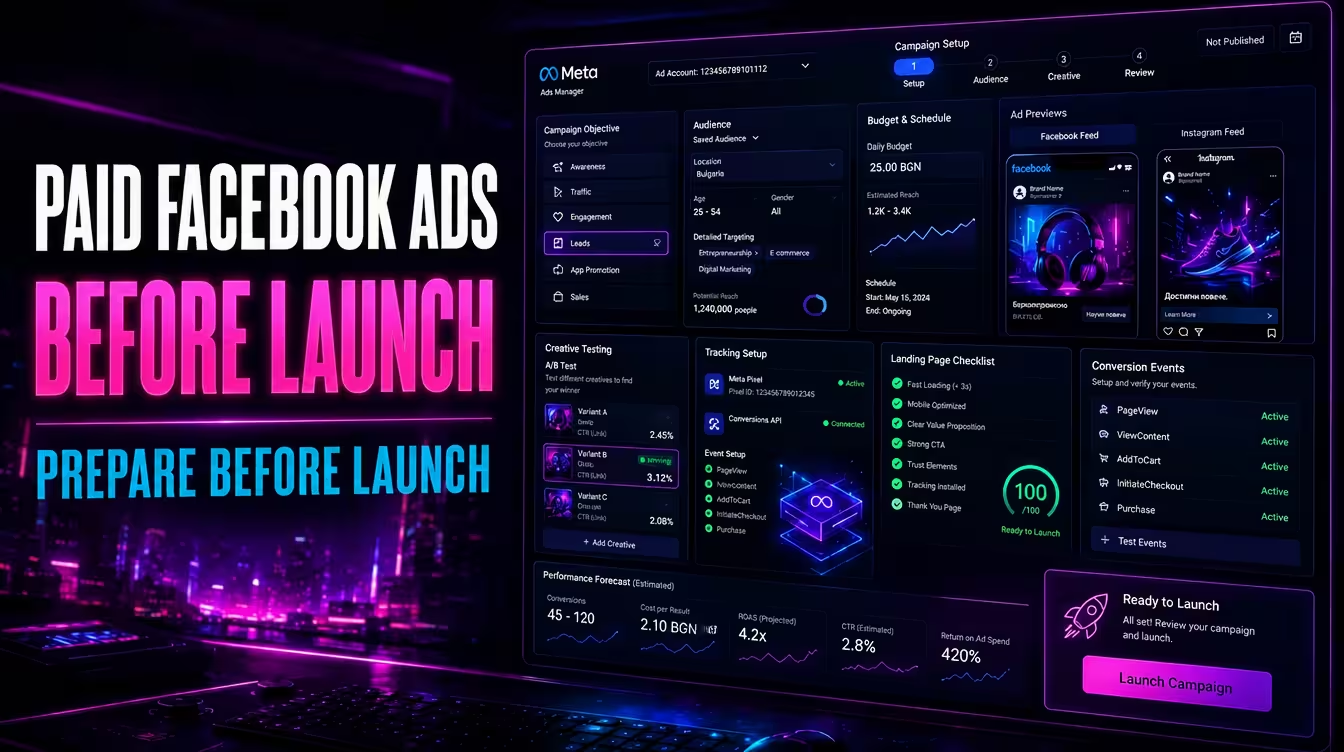
Paid Facebook advertising should not start from the Boost Post button. If you want real inquiries, registrations or sales, you first need to prepare the goal, audience, offer, creatives, page after the click and result tracking.
Many businesses start Facebook advertising in the wrong order. They have a post that looks good. They click Boost. They choose a broad audience. They add budget. After a few days, they see reach, likes and some clicks, but no real business result.
The problem is not necessarily the platform. The problem is that the campaign started without a foundation. Professional Facebook and Instagram advertising needs a complete, systematic approach.
Meta Ads can be a strong growth channel, but only if we know what we want to achieve, who we want to reach, what we will show them, where we will send them and how we will measure whether the campaign works.
What should you prepare before paid Facebook advertising?
Before launching paid Facebook advertising, prepare seven core elements:
- real campaign goal
- clear offer
- audience logic
- creative variations
- landing page or lead form
- Meta Pixel and Conversions API
- test budget and evaluation period
Without these elements, the campaign may spend budget without giving enough useful data. With them, the campaign can be tested, measured and improved.
First: what is the real campaign goal?
The goal should not be “more visibility” unless visibility is truly the business objective. For most businesses, the goal is more specific:
- qualified inquiries
- purchases
- registrations
- booked consultations
- phone calls
- lead form submissions
- remarketing to warm audiences
The campaign objective in Meta Ads should match that business goal. If the business needs leads, but the campaign is optimized for traffic or engagement, the platform may deliver cheap clicks without real results.
Second: the offer must be clear for a cold audience
Most people who see a Facebook ad are not actively searching for you. They are scrolling. That means the offer must be understandable quickly.
A good offer answers:
- what is being offered
- who it is for
- what problem it solves
- why it matters now
- what the next step is
- why the business is trustworthy
If the offer is unclear, creatives and targeting cannot fully compensate for it.
Third: audience is not only age, city and interests
Audience planning should go beyond basic demographics. A useful audience definition includes intent, context, behavior, stage in the funnel and expected objections.
Before launch, define:
- cold audiences
- warm audiences
- remarketing audiences
- excluded audiences
- lookalike audiences where relevant
- audience size and budget logic
A broad audience is not always bad, but it needs the right creative, enough budget and clear tracking.
Fourth: creatives should be prepared for testing, not for one version
One creative is not a test. Meta Ads usually needs multiple creative variations so the campaign can learn what message, visual and format works best.
Prepare variations by:
- message
- visual hook
- format: Feed, Story, Reels
- benefit
- problem statement
- proof or trust signal
- CTA
Strong creative preparation helps the campaign collect useful signals instead of guessing from one ad.
Fifth: you need to know where the person goes after the click
The page after the click is part of the campaign. It is not a separate detail.
Depending on the goal, the user may go to:
- landing page
- service page
- product page
- checkout
- Meta Lead Form
- booking page
- contact form
The post-click path should match the ad message. If the creative promises one thing and the page shows another, the user drops off.
If the website has traffic but no inquiries, fix the conversion path before scaling the budget.
Sixth: Meta Pixel and Conversions API must be ready before budget
Tracking should be ready before the campaign starts. If the campaign runs without proper tracking, the first budget may produce weak or misleading data.
At minimum, prepare:
- Meta Pixel
- key conversion events
- Conversions API where appropriate
- UTM tags
- GA4 events
- thank-you page or lead confirmation
- form and phone click tracking
Tracking allows the business to understand which creative, audience, page and objective create real value.
Seventh: the budget must be enough for testing, not only presence
A test budget should be large enough to collect signals. If the budget is too small, the campaign may not leave the learning stage or generate enough conversions to evaluate.
For many initial tests, a monthly Meta ad budget of 500-1,000 EUR is more realistic. In competitive niches or for scaling, 2,000+ EUR may be needed.
The exact amount depends on objective, niche, audience, expected cost per result and the quality of the conversion path. For detailed planning, see our guide to Facebook Ads cost.
What should you not do during the first 7-14 days?
- change every setting every day
- judge the campaign only by reach or likes
- stop before enough data exists
- scale too early
- add too many audiences at once
- test random creatives without a structure
- ignore landing page behavior
- optimize for clicks when the goal is leads or sales
The first phase should be used to read signals, not to make panic changes.
How do you know whether the campaign has potential?
A campaign has potential when early data shows that the audience responds, the creatives attract relevant users, the page supports the message and conversions are being tracked correctly.
Useful signals include:
- relevant engagement
- healthy click-through rate
- quality landing page behavior
- form starts or add-to-cart actions
- qualified leads
- reasonable cost per result
- clear difference between creative variations
Do not evaluate only by one metric. Read the full path from impression to business result.
When should you not start paid Facebook advertising?
It is better to delay launch when:
- the offer is unclear
- there is no landing page or usable lead form
- tracking is missing
- the website is broken or too slow
- the budget is too low for meaningful data
- there is no plan for handling leads
- the business expects instant results without testing
Launching before the basics are ready often makes Meta Ads look worse than it really is.
What should the business prepare and what should the agency handle?
| Area | Business input | Agency role |
|---|---|---|
| Goal | Business priority and expected result | Translate it into campaign objective and structure |
| Offer | Service, product, pricing logic, value | Clarify message, CTA and funnel logic |
| Audience | Ideal clients and context | Build audience structure and exclusions |
| Creatives | Brand assets, product/service context | Create hooks, formats, copy and test plan |
| Landing page | Business details and proof | Review or improve conversion path |
| Tracking | Access to tools and website | Set up Pixel, events, CAPI and reporting |
| Optimization | Feedback on lead quality | Improve budget, creative, audience and page direction |
Minimum checklist before launch
- clear business goal
- defined campaign objective
- clear offer
- audience structure
- creative variations
- landing page or lead form
- Meta Pixel installed
- conversion events tested
- Conversions API planned where needed
- UTM structure
- test budget
- evaluation window
- lead handling process
Real examples from practice
In strong Meta Ads projects, the result rarely comes from one button or one audience. It comes from preparation: clear offer, strong creative, relevant audience, conversion path and tracking.
When these parts are aligned, social advertising can support lead generation, registrations, sales and remarketing. When they are missing, the same budget can disappear into reach and clicks without business value.
Conclusion: good Facebook advertising starts before launch
Paid Facebook advertising is not just campaign activation. It is preparation, structure, testing, measurement and optimization.
If you start with Boost Post and hope the platform will solve everything, the results will often be unpredictable.
If you start with a clear goal, offer, audience, creatives, landing page, tracking and test budget, Meta Ads can become a measurable growth channel.
Ready to turn Meta Ads into a predictable client channel?
AdwayCreative can help you prepare and manage Facebook and Instagram advertising with clear strategy, tracking, creatives, landing page logic and optimization based on real data.
Frequently asked questions
What is paid Facebook advertising?
Paid Facebook advertising is advertising through the Meta Ads platform, which allows a business to reach selected audiences across Facebook, Instagram, Messenger, Stories, Reels and Audience Network. It can be used for inquiries, sales, registrations, traffic, remarketing and awareness.
What is the difference between Boost Post and a Meta Ads campaign?
Boost Post is a simplified way to promote a post. A Meta Ads campaign gives much more control over objective, audience, placements, budgets, conversion tracking, A/B tests and optimization. For business results, Ads Manager is usually the better option.
What do I need before launching Facebook ads?
Before launch, you need a clear goal, offer, audience, creatives, landing page or lead form, Meta Pixel, conversion tracking and test budget. Without these elements, the campaign can spend budget without giving enough useful data.
How much budget is needed for a first test?
For a meaningful initial test, we often recommend 500-1,000 EUR monthly ad budget paid to Meta. For more competitive niches or scaling, 2,000+ EUR may be needed. The exact amount depends on goal, niche, audience and expected cost per result.
Do I need a website?
Not always. Some campaigns can use Meta Lead Forms. But if the goal is higher-quality inquiries, more expensive services, B2B sales or eCommerce, a well-prepared landing page often gives more control, context and trust.
What is Meta Pixel?
Meta Pixel is code placed on the website to help track user actions after the click. It is important for measuring conversions, remarketing, creating audiences and optimizing campaigns.
What is Conversions API?
Conversions API sends conversion data from the server to Meta and complements Meta Pixel. It helps create more reliable tracking, especially with cookie limitations, iOS changes and ad blockers.
How long should I let the campaign run before evaluation?
Early data can appear in the first days, but a more meaningful evaluation is usually made after 7-14 days of initial testing and 30-60 days for more stable optimization. It depends on budget, data volume and campaign goal.
Why do my Facebook ads have clicks but no inquiries?
The most common reason is a mismatch between the ad, offer and page after the click. The audience may be too broad, the creative may attract the wrong people, the page may not convince users or tracking may not report the right actions.
Which is better: Google Ads or Facebook advertising?
Google Ads is stronger when people already search for a specific solution. Facebook advertising is stronger when you need to create interest, show a visual product, build trust or bring back people who already interacted with your brand. In many cases, both channels work best together.
- About the Author
- Latest Articles
- Client Results

With more than fifteen years of hands-on experience in PPC, SEO, content marketing and social media, Iliya Avramov has built deep expertise in combining performance marketing strategy with modern digital systems. As founder of AdwayCreative, he works across Google Ads, Meta Ads, technical SEO, conversion-focused websites and growth frameworks for startups, B2B companies, service businesses and eCommerce brands.
His work is focused on practical, measurable outcomes: stronger lead quality, cleaner tracking, better conversion paths and campaigns that connect advertising spend to business value. Iliya has managed marketing budgets from $1,000 to more than $100,000 per month and has supported campaigns across industries including agriculture, healthcare, education, retail, professional services and international eCommerce.
He works with tools and data sources such as Google Analytics, Google Ads, Meta Ads, Search Console, SEMrush, Ahrefs and AI-assisted analysis. His approach follows current best practices from resources such as Google Search Central and Think with Google, while grounding recommendations in real campaign data and client results.
His leadership has helped AdwayCreative earn multiple industry recognitions, including:
2020: 3D visualization and graphic design recognition (Acquisition International).
2021: Media innovator recognition (Corporate Vision).
2022: Martech recognition (Corporate Vision).
2022: Global Finance recognition (Global Banking & Finance).
2023: Global Finance recognition (Global Banking & Finance).
2023: Full-service marketing and advertising agency recognition (Innovation in Business).
2024: Highly reviewed social media marketing agency in Bulgaria (The Manifest / Clutch).
2025: Customer satisfaction recognition in advertising and marketing (Global Banking & Finance).
Author disclosure: Iliya Avramov is the founder of AdwayCreative and may reference agency services in his content. Opinions and recommendations are based on professional experience, campaign data and independent research, with no hidden sponsorships.


