

Quick overview
If a website has traffic but no inquiries, the problem is rarely only advertising or only SEO. Usually there is a mismatch between visitor intent, page message, trust, UX structure, the contact form, and conversion tracking.
- Traffic shows that people reach the website. Inquiries show whether the website convinces them to take the next step.
- The most common causes are unclear messaging, weak landing page structure, lack of trust, poor mobile UX, the wrong type of traffic, or incorrect tracking.
- SEO and ads bring people to the website, but web design and CRO decide whether those people become clients.
- Without proper analytics setup, a business may see visits but not where potential clients actually drop off.
- The answer is not always more traffic. Often, the funnel must be fixed before budget is increased.
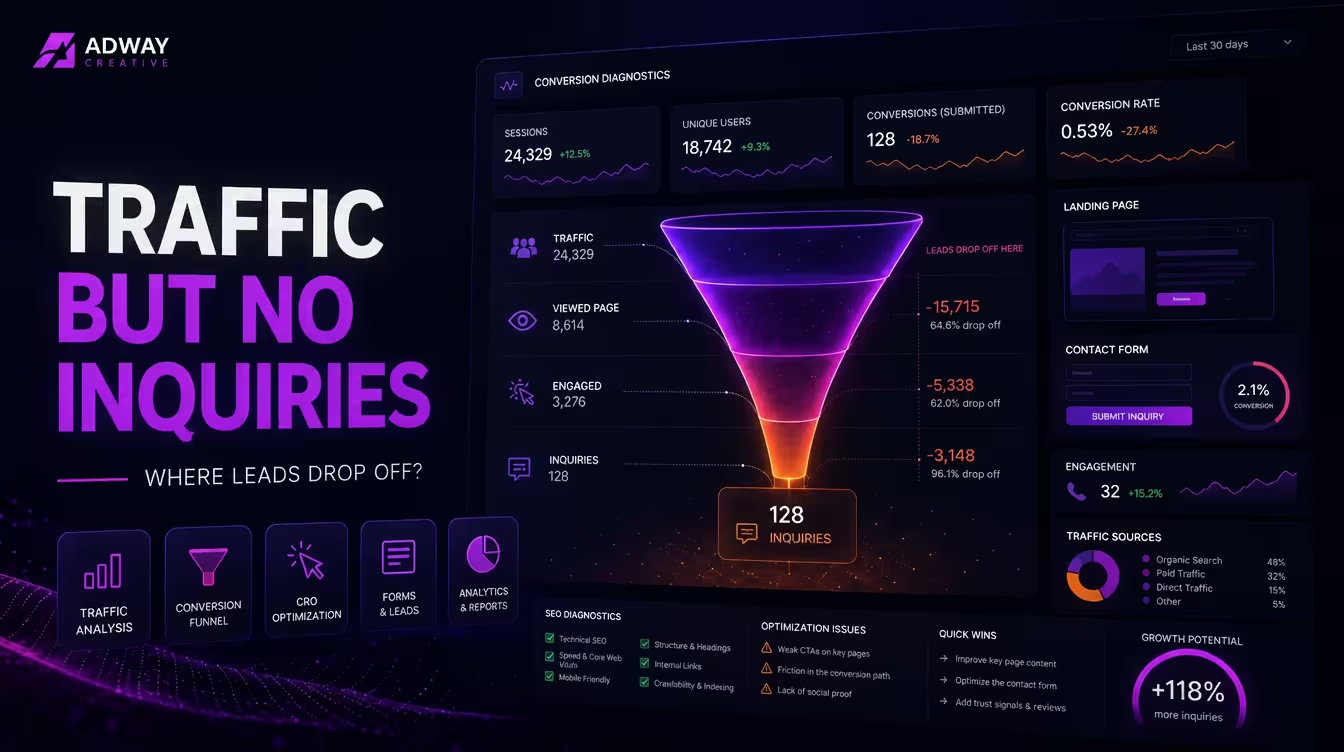
Why does a website have traffic but no inquiries?
A website has traffic but no inquiries when visitors reach the page but do not see enough clarity, trust, or a convenient path to contact the business. The issue may be in design, content, the offer, technical measurement, SEO intent, or the quality of advertising traffic.
The dangerous part is that everything can look like it is working. Google Analytics shows visits. Ads bring clicks. SEO pages are indexed. Users enter the site.
But the phone does not ring. Forms do not arrive. Inquiries are few, random, or low quality.
This is the moment when many businesses reach the wrong conclusion: they assume they need more traffic. In reality, they often need a better conversion path.
More traffic does not fix a weak conversion path
More traffic can help only when the website is already capable of converting the right visitors. If the page is unclear, the offer is weak, the CTA is hidden, or the contact form creates friction, more visits simply create more lost opportunities.
Before increasing budget, ask a more practical question: what happens after the visitor lands on the page?
Traffic is not the goal. Qualified traffic that reaches a clear next step is the goal.
1. Traffic is not the same as commercial intent
A visitor can arrive through Google, a social post, or an ad and still not be ready to contact you. Some users are researching. Others are comparing options. Some are looking for information, not a provider.
This is common when SEO pages rank for broad topics or ads target audiences that are too wide.
To understand the problem, compare traffic sources:
- Which channels bring engaged visitors?
- Which pages attract people with buying intent?
- Which campaigns generate real inquiries, not just clicks?
- Which keywords or audiences bring low-quality visits?
Good traffic has context. It reaches the website with a need that matches the page and the offer.
2. The first screen does not say “this is for me” quickly enough
The first screen is where users decide whether to continue. If the headline, subheading, visual, and CTA do not quickly explain the value, many visitors leave before reading anything else.
The first screen should answer:
- What does this business offer?
- Who is it for?
- What problem does it solve?
- Why should I trust it?
- What is the next step?
If the first screen is beautiful but vague, it may create a design impression without creating a business result.
Quick diagnostic test
- Can a new visitor understand the offer in five seconds?
- Is there a visible CTA without scrolling?
- Does the page speak to a specific need?
- Is the next step clear?
- Does the mobile version show the same clarity?
If several answers are no, the site may have a communication problem, not a traffic problem.
3. The page talks about the business, but not the client’s problem
Many websites explain the company, the team, the history, or the services, but do not connect clearly to the user’s pain point.
A visitor usually thinks in practical questions:
- Can this solve my problem?
- Is this relevant to my situation?
- How does the process work?
- What will I get?
- How much risk is involved?
- What happens after I send a request?
When the page does not answer these questions, visitors may postpone the decision or choose a competitor that feels clearer.
For service businesses, a professional website should be built around the real path to inquiry, not only around a list of services.
4. CTA buttons are too few, unclear, or placed in the wrong locations
A call-to-action is not just a button. It is the transition between interest and action.
Weak CTA patterns include:
- generic text such as “Learn more” when the user is ready to act
- only one contact button at the bottom of the page
- CTA buttons that disappear on mobile
- too many different CTAs competing with each other
- no clear expectation about what happens after the click
A stronger CTA tells the user what to do and why the step is worth taking.
5. The contact form creates more friction than trust
Contact forms often look like a small detail, but they can stop a motivated visitor at the final step.
Common problems include:
- too many required fields
- unclear labels
- technical errors
- no confirmation message
- no expectation about response time
- missing phone or email alternative
- poor mobile usability
The form should make the next step feel simple and low risk. If it feels like work, some users will leave.
6. The mobile version loses the most valuable visitors
Most users now judge a website on mobile first. A desktop design can look polished while the mobile version creates friction.
Mobile problems that reduce inquiries include:
- slow loading
- CTA buttons below too much content
- forms that are hard to fill in
- small text or crowded sections
- menus that hide key pages
- visuals that take too much space
- click-to-call not available
If the mobile experience is weak, the site can have traffic and still lose the users most likely to contact the business.
7. The website does not build enough trust before asking for contact
Before a visitor sends an inquiry, they evaluate risk. They want to know whether the business is credible, experienced, responsive, and relevant.
Trust signals include:
- client results
- reviews
- case studies
- clear process
- real contact details
- professional visuals
- transparent service scope
- FAQ sections
- proof that the business understands the problem
If the site asks for contact too early, before building trust, users may leave to compare more options.
What we check when a website has traffic but no inquiries
| Area | What we check | Why it matters |
|---|---|---|
| Traffic | Sources, keywords, campaigns, audience quality | Visits must match the offer |
| First screen | Headline, value proposition, CTA, mobile view | Users decide quickly whether to continue |
| Content | Clarity, objections, benefits, service scope | The page must support the decision |
| Trust | Reviews, case studies, proof, process | Users need confidence before contact |
| CTA | Text, placement, repetition, relevance | The next step must be obvious |
| Forms | Fields, errors, confirmation, response expectation | Final-step friction kills inquiries |
| Analytics | Events, conversions, source attribution | You need to know where users drop off |
8. Analytics shows visits, but not decisions
Analytics is useful only when it tracks meaningful actions, not just pageviews.
At minimum, a lead-focused website should track:
- submitted forms
- phone clicks
- email clicks
- CTA clicks
- thank-you page visits
- conversion rate by channel
- conversion rate by device
- form abandonment
Without this setup, the business sees that traffic exists but cannot see whether people try to contact, where they stop, or which source brings quality leads.
9. SEO pages bring visits, but do not lead to the next step
SEO can bring traffic from people who are still researching. That traffic can be valuable, but it needs a path forward.
SEO pages should connect to:
- service pages
- case studies
- consultation CTAs
- related guides
- comparison content
- clear next steps
If the article answers a question but does not continue the user journey, it may generate visits without inquiries.
For broader planning, see our guide to 360 digital strategy, where website, SEO, ads, and content work as one system.
10. Advertising brings traffic, but the website does not continue the conversation
An ad creates an expectation. The landing page must continue that same message.
When ads and pages do not match, users feel friction. For example:
- the ad promises a specific service, but the page is too general
- the ad speaks to a problem, but the page lists company information
- the ad targets a high-intent keyword, but the page has no clear CTA
- the campaign sends users to the homepage instead of a relevant landing page
This is why Google Ads and CRO should be planned together. A campaign can bring the right user, but the page must finish the conversation.
11. When is the problem CRO, and when is it already redesign?
Not every website with weak inquiries needs to be rebuilt. Sometimes targeted CRO improvements are enough.
CRO may be enough when:
- the website is technically stable
- mobile performance is acceptable
- the structure is mostly usable
- content can be improved without rebuilding everything
- forms and tracking can be fixed
A redesign becomes more reasonable when:
- the site is slow or outdated
- mobile UX is structurally weak
- the page structure does not support the business model
- the design does not build trust
- service pages cannot be improved cleanly
- tracking and conversion paths are broken across the site
If budget is a concern, our guide to website development cost can help you understand what affects the scope.
How to understand where the problem is
Start with a simple funnel diagnosis:
- Which pages receive the most traffic?
- Which sources bring those users?
- What does the first screen communicate?
- Where are the CTAs?
- Do forms and phone links work?
- What does mobile behavior look like?
- Which events are tracked?
- Which pages generate real inquiries?
This turns the problem from a vague concern into a practical action list.
12. The right approach: website, SEO, CRO, and analytics as one system
A lead-focused website works best when the core parts support each other.
- SEO brings relevant demand.
- Ads bring targeted visitors.
- Web design creates clarity and trust.
- CRO improves the path to action.
- Analytics shows what actually works.
If these parts are managed separately, the site can have traffic but still fail to generate inquiries.
This is the logic behind the AdwayCreative Growth Framework: the website, campaigns, content, tracking, and optimization should work as one growth system.
13. What can you do this week?
- Test every contact form on desktop and mobile.
- Check whether phone and email clicks are tracked.
- Review the first screen on your top traffic pages.
- Compare conversion rate by channel and device.
- Add clearer CTAs to high-traffic pages.
- Check whether SEO articles link to service pages.
- Review whether ads send users to relevant landing pages.
- Add trust signals before the main CTA.
- Remove unnecessary fields from contact forms.
- Document where users drop off before changing budget.
These checks do not replace a full audit, but they often reveal why traffic is not becoming inquiries.
Does your website have traffic but not enough inquiries?
AdwayCreative can help you analyze the website, traffic sources, landing pages, CRO path, forms, analytics setup, and advertising structure so you can understand where potential clients are being lost.
Frequently asked questions
Why does a website have visits but no inquiries?
The most common reason is a mismatch between traffic and the conversion path. Visitors enter the website, but they do not see a clear message, enough trust, a specific offer, or an easy next step. The problem can also be a broken form, weak mobile UX, or incorrect measurement.
How do I know whether the problem is the website or advertising?
Compare behavior by traffic source. If all channels have low conversion, the problem is probably in the website or offer. If only paid traffic does not convert, check keywords, targeting, ad message, and landing page match.
What is CRO optimization?
CRO optimization is the process of improving a website so a higher percentage of visitors complete a desired action: inquiry, call, purchase, registration, or consultation request. It includes analysis of behavior, UX, content, CTA, forms, and trust signals.
Do I need a new website if the current one has traffic?
Not always. If the technical foundation is solid, CRO improvements, new CTAs, better content, and analytics setup may be enough. But if the site is outdated, slow, hard to use on mobile, or structurally weak, redesign may be the more effective solution.
Can SEO traffic fail to bring clients?
Yes. SEO can bring visits from people who are looking for information but are not ready to send an inquiry. That is why SEO content needs clear internal links to services, case studies, CTA blocks, and pages that continue the user journey.
Which conversion events should be tracked?
At minimum, track submitted forms, phone clicks, email clicks, CTA clicks, and thank-you page visits. For deeper analysis, add scroll depth, form abandonment, conversion source, and conversion rate by device.
What should I do first if my website has traffic but no inquiries?
First, check whether forms work and conversion tracking is configured correctly. Then analyze the top traffic pages, mobile version, CTA buttons, first screen, and visitor sources. Do not increase ad budget before you know where people drop off.
- About the Author
- Latest Articles
- Client Results

With more than fifteen years of hands-on experience in PPC, SEO, content marketing and social media, Iliya Avramov has built deep expertise in combining performance marketing strategy with modern digital systems. As founder of AdwayCreative, he works across Google Ads, Meta Ads, technical SEO, conversion-focused websites and growth frameworks for startups, B2B companies, service businesses and eCommerce brands.
His work is focused on practical, measurable outcomes: stronger lead quality, cleaner tracking, better conversion paths and campaigns that connect advertising spend to business value. Iliya has managed marketing budgets from $1,000 to more than $100,000 per month and has supported campaigns across industries including agriculture, healthcare, education, retail, professional services and international eCommerce.
He works with tools and data sources such as Google Analytics, Google Ads, Meta Ads, Search Console, SEMrush, Ahrefs and AI-assisted analysis. His approach follows current best practices from resources such as Google Search Central and Think with Google, while grounding recommendations in real campaign data and client results.
His leadership has helped AdwayCreative earn multiple industry recognitions, including:
2020: 3D visualization and graphic design recognition (Acquisition International).
2021: Media innovator recognition (Corporate Vision).
2022: Martech recognition (Corporate Vision).
2022: Global Finance recognition (Global Banking & Finance).
2023: Global Finance recognition (Global Banking & Finance).
2023: Full-service marketing and advertising agency recognition (Innovation in Business).
2024: Highly reviewed social media marketing agency in Bulgaria (The Manifest / Clutch).
2025: Customer satisfaction recognition in advertising and marketing (Global Banking & Finance).
Author disclosure: Iliya Avramov is the founder of AdwayCreative and may reference agency services in his content. Opinions and recommendations are based on professional experience, campaign data and independent research, with no hidden sponsorships.


