In brief: If you are considering working with a digital agency on a new website, Google Ads, Meta Ads or a wider marketing project, establish the scope, responsibilities, stages and measurement approach as well as the price.
- A quote and a strategy are different. We can provide an indicative price after an initial discussion; detailed research and planning require separate work.
- Your website, advertising and tracking need to work together. Visits and attractive reports are not enough without meaningful customer actions.
- Advertising spend is separate from agency services. One-off development, initial setup and monthly management also have different scopes.
- Agree on control and terms upfront, including access to your own accounts, reporting, approvals and termination.
We receive enquiries from many kinds of businesses, from local services and B2B companies to healthcare services and sites with more complex payments and subscriptions. The same questions often come up: “How much will it cost?”, “What exactly is included?”, “How many enquiries will I get?”, “Do I need a long-term contract?” and “Who owns the website and data?”
These are reasonable questions. Iliya Avramov’s practical experience since 2007, together with our work at AdwayCreative, shows us that a good partnership starts by understanding the business problem and how we will measure progress. Here we bring together the answers we give most often, with examples from our actual work. There is no universal recipe, but the right questions can save time and prevent poor investments.
What do we need to know about your business before proposing a website or advertising?
We need to understand what you sell, to whom, where, on what terms and what a successful order looks like. Without that, we could create an attractive website that is not necessarily a useful business tool.
We usually start with your services and products, priority audiences, service areas, indicative prices or pricing method, team capacity and how customers place an order. We also ask what materials you already have—photos, videos, reviews and catalogues—and who handles enquiries.
For an emergency service, a person may need to call within seconds. For post-renovation cleaning, they want to know what is included, how pricing works and whether an inspection is needed. For dental consulting, the information collected, language of communication and handling of personal data matter. One identical homepage and contact form cannot optimally serve all three situations.
We do not expect clients to invent the structure, SEO copy and user journey themselves. Clients bring knowledge of their business; our job is to turn it into a useful web structure and marketing communication.
Why don’t we provide a detailed three-month strategy in the first email?
An indicative price proposes a scope; a tailored strategy is the result of research. It would be misleading to present assumptions as proven solutions.
In an initial conversation, we can explain the process, which services are likely to be needed and what initial costs to anticipate. The choice of channels, allocation of budgets across services, competitor and keyword analysis and realistic forecasts require data and work.
For some projects Google Ads Search is the sensible first step. Others need the website fixed, conversions configured or the offer clarified first. A B2B partnership channel may need a different page, commercial terms and follow-up process.
We would rather say “we need to research this” than sell apparent certainty with a ready-made strategy for a business we do not yet know.
What does paid research mean? An agreed scope, review of relevant data, analysis of opportunities and specific recommendations. It is not automatically included in every preliminary quote; when needed, its price and deliverable are agreed in advance.
How is the price determined and what exactly am I paying for?
We divide the investment into clear components. This helps both a small business that needs one service and a company developing several channels over time.
| Component | What it means | How it is paid |
|---|---|---|
| Website or landing page development | Structure, design, content, forms, mobile version and agreed functionality | One-off, according to scope |
| Initial advertising setup | Technical foundation, structure, campaigns and necessary tracking | One-off for the agreed scope |
| Monthly advertising management | Analysis, testing, optimisation, monitoring and reporting | For an agreed period |
| Advertising budget | Spend paid to Google, Meta or another advertising platform | Separate from the agency fee |
| Additional work | Advanced integrations, new pages, specialist strategy, content and video | Under a separate agreement |
For example, our public Google Ads pricing information separates ad spend from setup and management fees. The price depends on the number of campaigns, complexity and workload, not only the amount spent on clicks.
For website development, a small one-page structure differs from a corporate site with multiple services, languages, integrations and custom functions. Seven or eight sections are not seven or eight separate pages. The quote should make this explicit.
Clients should not have to guess whether policies, hosting, a domain, paid services, new ad creatives or subsequent technical support are included. We clarify these terms before work begins.
Why is the website often built before the advertising campaign?
Paid traffic needs a destination that answers the customer’s question and makes the next action easy. Advertising cannot compensate for unclear services, hidden prices, a difficult form or an inconvenient mobile interface.
When planning a local service website, we consider what a visitor needs to see immediately: the service, area covered, a realistic promise, telephone number, form or another suitable contact method. The phone takes priority for an emergency service; a B2B enquiry may be better served by a form asking about the company and its needs.
Depending on the project, we can start with a compact landing page and later expand it into a full business website. This is a business decision, not a competition over page count.
Development also includes checking the actual services and claims. We would not publish “available 24/7”, “arrival within 20 minutes” or “no extra fees” unless the client can confirm them.
What materials does the client provide, and what do we create?
We ask for business information, not finished marketing copy. A correct service list, delivery terms, pricing logic, real photos, documented advantages, contact details and any limitations are most useful.
We can then organise the structure, prepare and edit copy, and suggest sections, calls to action, images, questions and answers and the basic SEO architecture. Content requiring specialist confirmation—medical claims, legal terms, commercial guarantees or privacy policies—is checked and approved by the responsible specialist or client.
For multilingual projects, we first establish the audience and path to enquiry. Translation is more than replacing words: examples, questions, services and explanations may need adapting.
Can we start with a 30-day pilot campaign without a long-term contract?
Yes, when the scope permits. A pilot can test actual demand, user behaviour and the quality of the initial setup without committing to every marketing service from day one.
We list the required page, one-off setup, management and ad budget separately. If we agree on 30 days of advertising management, the period begins when the campaign actually launches, not at the first conversation or when website work begins, unless otherwise agreed.
It is important to understand what a test proves. Thirty days can provide useful initial data on costs, searches, contact actions and page performance. It does not guarantee a number of sales and may not be enough for a reliable long-term forecast.
With a limited budget, we generally favour a focused test of selected services over spreading a small amount across many campaigns and channels.
How do we determine an appropriate advertising budget?
We do not start with a universal number. The starting point is demand, competition, expected cost per visit, possible enquiry rate and the economics of an order.
Our practical experience helps us suggest an initial range, but market research and account data determine whether it is sufficient. A small daily budget may make sense for a limited pilot without covering every service, area and hour of demand.
Once a campaign starts, we monitor not only spend but also which searches, services and actions it generates. We do not automatically increase the budget because the system says it is limited; first we check whether available funds are being used well.
What is a conversion, and when is an enquiry qualified?
This is one of the most important questions to settle before assessing advertising results.
| Level | What we actually know | What we do not yet know |
|---|---|---|
| Visit / click | Someone opened the website or clicked an ad | Whether they intend to buy |
| Phone or Viber click | Someone showed interest in making contact | Whether a conversation took place and what it concerned |
| Valid form submission | An enquiry was received with entered details | Whether the person meets the criteria and will order |
| Qualified enquiry | A review confirms a match with the service, area and actual need | Whether a deal will follow |
| Completed order | The client has confirmed a sale, contract or payment | Actual profit without cost data |
In Google Ads, we can configure separate conversions for forms, phone interactions and other actions. We can also assign different values to enquiry types if they reflect real business priorities. A higher event value does not itself prove that someone became a customer.
For a B2B enquiry, “qualified” might mean a company with a specific need, budget, location and realistic contract opportunity. For an urgent local service, it might mean someone in the service area requesting a service the team actually offers. Criteria should be agreed in advance and, where necessary, confirmed through client feedback or a CRM.
When we have data to distinguish them, we do not mix job calls, requests outside the service area and genuine customer contacts. Linking advertising to completed orders also requires a process for feeding deal information back; tracking a click alone is insufficient.
Click ≠ conversation. Conversation ≠ qualified enquiry. Enquiry ≠ completed sale. Good reporting shows which level we have reached.
What does monthly Google Ads management actually include?
We do not consider management to mean creating ads once and leaving them alone. Within the agreed scope, we review actual searches, keywords and negative keywords, ad messages, landing-page relevance, costs, conversions and the competitive environment.
We analyse ad quality, Ad Rank, impression share and bidding strategies. With sufficient data, a bidding change may make sense; in other cases, copy, structure, measurement or the page should improve first. A higher position is not a business goal in itself if it brings more expensive or less suitable contacts.
When we also work on the website, we include ongoing behaviour analysis and small CRO adjustments, such as improvements to service clarity, buttons, forms or information order. A major redesign, new functionality and new campaigns are separate work unless explicitly included.
We explain the ongoing work in more detail in what Google Ads account management includes.
What reports do I receive, and can I see spending in real time?
Clients should be able to see what is happening in their own advertising and analytics accounts. Alongside direct access, we agree on communication: operational conversations when needed, periodic summaries and performance reporting.
A useful report includes ad spend, clicks, key conversions, cost per recorded enquiry, movement against the previous period and the optimisations made. If enquiry quality has not been checked, we say so rather than presenting enquiries as confirmed sales.
Weekly communication can be useful for a new campaign. The format and frequency of formal reports are agreed according to the package rather than promised at the same level for every project.
How do we approach B2B clients and ongoing partnerships?
Attracting a one-off individual customer and a continuing business partner are different tasks. For B2B, we start with the offer: what the company receives, who delivers it, the terms, capacity and next step.
A separate B2B section or page with specific benefits, examples and a form asking about the company and project is often useful. We can then assess the potential of a Search campaign based on business intent and, where justified, other channels. Neither Google Ads nor Meta Ads guarantees reaching every manager or decision-maker.
Without clear commercial terms and a process for handling B2B enquiries, even well-targeted advertising cannot solve the problem on its own.
Who owns the domain, website, advertising accounts and data?
As a rule, we work so that clients retain ownership and administrative control of their business assets. The domain and relevant registrations should be under their control; advertising and analytics accounts are accessed through granted permissions, not used to lock clients in.
We also clarify what is handed over when a project ends: website access, documentation, content, settings and information about external services. Rights to materials, licensed images, software components, paid plugins and custom-developed elements are described in the agreed terms. It would be wrong to promise that every externally licensed resource becomes the client’s property.
For sites processing personal or health data, we also establish who receives requests, which data is genuinely needed, how consent is obtained and which policies and technical measures are required. This is part of responsible preparation, not fine print in the footer.
What are the stages, and when is payment due?
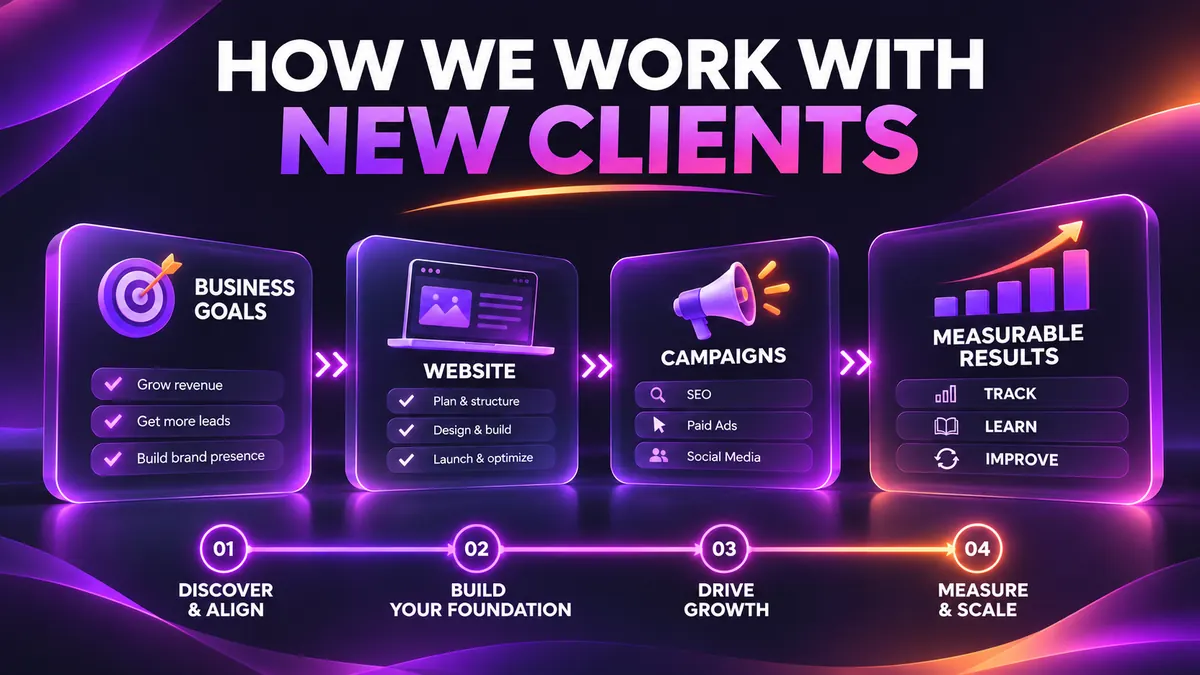
A good proposal specifies the deliverable, price, dependencies and payment timing for each stage. The usual logical sequence is: clarify the business need → scope and proposal → website development and approval → technical setup and tracking → campaign launch → measurement and optimisation.
This is not a universal calendar. If a working website already exists, we may start with an audit or setup. If a site still needs to be built, advertising should not start before a reliable landing page and checked contact actions are in place.
The deposit, final payment, feedback deadlines and acceptance criteria appear in the specific proposal. Timing also depends on receiving necessary materials and approvals, particularly for medical content, subscriptions, payments or projects involving multiple participants.
What is the difference between a technical audit and fixing the problems?
This distinction matters especially for a live site with payments, subscriptions or complex integrations. An audit identifies problems, causes, risks and recommendations; it does not automatically authorise changes to the running system.
On one real project, we performed a paid read-only technical audit. The work included inspection and written findings, but not unauthorised plugin removal, payment changes or website fixes. Implementation can then be priced separately and approved in stages.
This protects both sides: the client knows what they are paying for, and their live business does not become a test environment without consent. If a fact cannot be verified with the available access, that should be stated honestly too.
Can I end the service, and what happens after the first month?
We do not believe a good partnership should depend on unclear dependencies or locked accounts. A pilot has an agreed term; afterwards we present the results so the client can decide whether to continue.
If we continue, we agree on the next month’s scope and budget. If the engagement ends, we settle agreed work completed, hand over the promised materials and help manage access according to the terms. Notice periods, licences, hosting and support should be clarified in advance and may differ by project.
Can an agency guarantee an exact number of enquiries or sales?
We cannot responsibly guarantee a specific number of orders before checking demand, competitors, prices, the landing page and actual service delivery. Even after research, a forecast remains a forecast.
We can take clear responsibility for the agreed work: correct setup, diligent optimisation, tracking, transparent communication and explaining what the data shows. If the initial hypothesis is not supported, we should adjust the approach or explain why we do not recommend further spending.
The worst thing we could do is present clicks as sales or promise that more budget will necessarily solve the problem.
A real example: why the website, tracking and budget must work together
For Vasilevi Clean, a family-run professional cleaning company in Sofia, the work did not begin with simply “launch Google Ads”. There were questions about controlling costs, presenting services clearly and measuring reliably. We built a one-page website, organised service and pricing information and configured tracking for contact actions—phone clicks, valid form submissions and successfully sent chat messages, not merely opening the chat.
From 16 February to 15 June 2026, advertising generated more than 90 actual enquiries confirmed by the client, with approximately €2,480 in ad spend and an average of around €27.10 per confirmed enquiry. These are enquiry figures, not a claim of 90 completed orders. The full Vasilevi Clean case study explains both the results and their limitations.
Other real projects led to different conclusions: an urgent local service needed the phone number above all else; a dental consulting project needed clarity on data flow and consent; and a site with complex payments required diagnosis to be separated from authorisation for changes. That is why we do not sell the same formula to every business.
Our principle is straightforward: understand the business goal, build the right foundation, attract traffic and measure what actually happens. This is the logic of the AdwayCreative Growth Framework: diagnosis, building, attraction, optimisation and sustainable development.
Before requesting a quote: what is enough to send us?
You do not need a finished marketing plan. Tell us about your business, main services, target region, the problem you want to solve and an approximate budget range. From there we can assess whether the next sensible step is a specific proposal, a limited pilot or paid research.
Frequently asked questions about working with a digital agency
Can I get an indicative price first?
Yes. If the initial scope is sufficiently clear, we can give a price range. The final proposal depends on features, content, integrations and agreed deliverables.
Why is the ad budget not included in the monthly fee?
The ad budget is paid to the platform for displaying ads; the fee covers setup and management. Separating them gives clearer control over costs.
Can I start with just a website and Google Ads?
Yes, if that is a sensible starting scope for the business. Meta Ads, SEO content, video and other services can be discussed later without being automatically included in the first proposal.
When do the 30 days of advertising management start?
When a 30-day advertising pilot is agreed, the period can begin when the campaign is actually activated. The exact date and renewal terms are recorded in advance.
Can I see Google Ads spend in my own account?
Yes. We work with access to client accounts so the owner retains control and can monitor available data. Periodic summaries and analysis supplement that access.
Does a phone click count as an actual customer?
No. It proves interaction with the button, not a completed conversation or order. Where possible, we add more reliable measurement and feedback on contact quality.
How do you determine whether a B2B enquiry is qualified?
Using agreed criteria such as company type, need, location and potential project, followed by the team’s assessment. An automatically assigned form value does not replace confirmation of the actual business outcome.
Are major website changes included in monthly advertising management?
Not automatically. Small ongoing CRO adjustments may be part of the agreed management, but new functionality, a major redesign and standalone pages are agreed separately.
Does a paid audit include the fixes?
No, unless explicitly stated. The audit provides diagnosis and recommendations; fixes are priced and approved as a separate step, especially on live systems.
What happens if we do not continue after the first month?
We follow the agreed closing terms, hand over what was agreed and help settle access and paid external services. Future servicing does not need to be included automatically in the pilot proposal.
- About the Author
- Latest Articles
- Client Results

With more than fifteen years of hands-on experience in PPC, SEO, content marketing and social media, Iliya Avramov has built deep expertise in combining performance marketing strategy with modern digital systems. As founder of AdwayCreative, he works across Google Ads, Meta Ads, technical SEO, conversion-focused websites and growth frameworks for startups, B2B companies, service businesses and eCommerce brands.
His work is focused on practical, measurable outcomes: stronger lead quality, cleaner tracking, better conversion paths and campaigns that connect advertising spend to business value. Iliya has managed marketing budgets from $1,000 to more than $100,000 per month and has supported campaigns across industries including agriculture, healthcare, education, retail, professional services and international eCommerce.
He works with tools and data sources such as Google Analytics, Google Ads, Meta Ads, Search Console, SEMrush, Ahrefs and AI-assisted analysis. His approach follows current best practices from resources such as Google Search Central and Think with Google, while grounding recommendations in real campaign data and client results.
His leadership has helped AdwayCreative earn multiple industry recognitions, including:
2020: 3D visualization and graphic design recognition (Acquisition International).
2021: Media innovator recognition (Corporate Vision).
2022: Martech recognition (Corporate Vision).
2022: Global Finance recognition (Global Banking & Finance).
2023: Global Finance recognition (Global Banking & Finance).
2023: Full-service marketing and advertising agency recognition (Innovation in Business).
2024: Highly reviewed social media marketing agency in Bulgaria (The Manifest / Clutch).
2025: Customer satisfaction recognition in advertising and marketing (Global Banking & Finance).
Author disclosure: Iliya Avramov is the founder of AdwayCreative and may reference agency services in his content. Opinions and recommendations are based on professional experience, campaign data and independent research, with no hidden sponsorships.