

Key takeaways
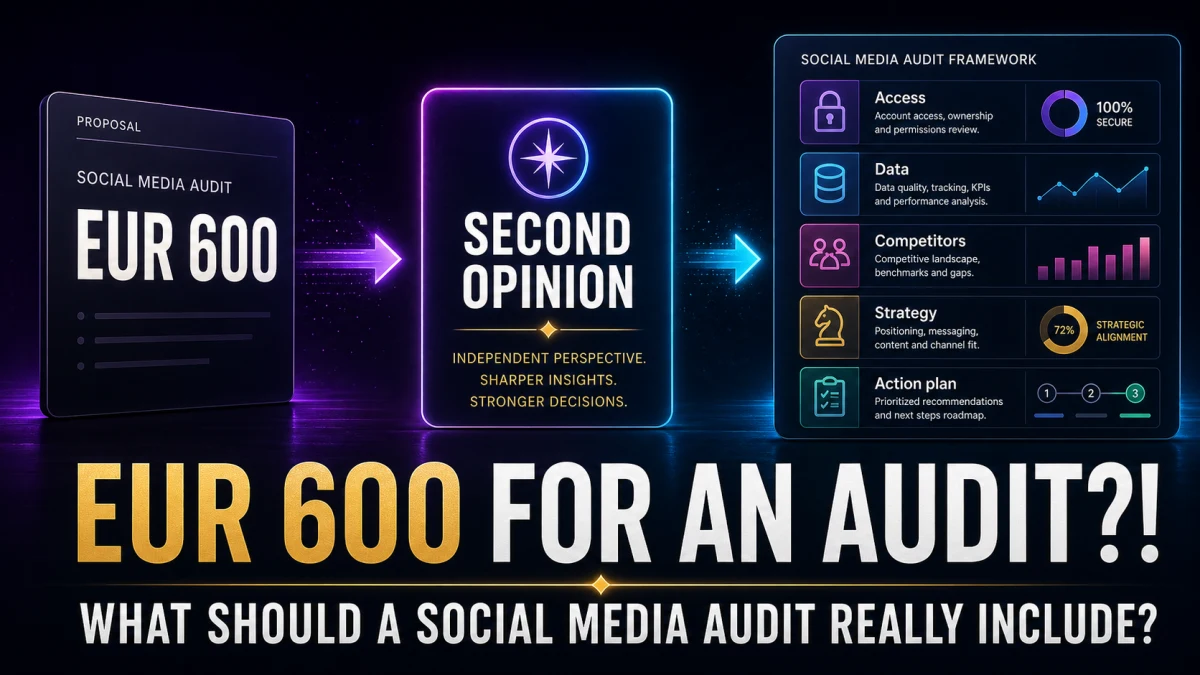
- EUR 600 for a social media audit?! They asked us for a second opinion after a business seeking help with future Facebook and Instagram content was told to pay for an audit of almost inactive profiles first — without any internal access being requested and without a clearly defined final deliverable.
- A social media audit can cost EUR 600 or more when it includes a genuine analysis of data, audience, content, competitors, tracking, strategy and a concrete action plan.
- If the provider has not requested access to Meta Business Suite, Instagram Insights or other available data, they can perform only a limited public review — not a full performance audit.
- When profiles have been inactive for years, there is little value in paying a substantial sum merely to establish that “not enough is being published”.
- Before paying, ask for a specific deliverable: what will be analysed, what data will be used, what document you will receive and what practical actions will follow.
- The issue is not whether the service is “expensive”. It is whether there is enough work and value behind the price.
A social media audit is a structured review of a business’s current presence on Facebook, Instagram and other relevant platforms. It should end with specific findings and actions.
What does a social media audit actually involve?
“We reviewed your profile and think you should post more often.”
A professional audit can examine several distinct layers:
- the current public presence;
- historical performance data;
- the content;
- the audience;
- the competitors;
- the advertising infrastructure;
- the tracking setup;
- the connection to the website;
- the business objectives;
- a concrete next-step plan.
That is exactly why the price alone does not tell us whether an audit is expensive or inexpensive.
First, we need to know what is being bought.
“We reviewed your profile and think you should post more often.”
Only partly.
Without internal access, a specialist can analyse publicly visible elements such as:
- profile and cover image;
- bio and description;
- links;
- visible posts;
- posting frequency;
- formats;
- visual consistency;
- core messages;
- public reactions and comments;
- competitors’ public presence.
This can be useful.
But it is not the same as a full performance audit.
Without the required access, it is usually not possible to analyse reliably all the internal metrics that matter to the work.
For example:
- historical reach;
- impressions;
- profile activity;
- audience breakdown;
- content performance;
- engagement trends;
- Instagram Insights;
- Meta Business Suite data;
- advertising history;
- Pixel and event setup;
- Conversions API;
- attribution;
- the real connection between social channels and the website.
A public review is not useless.
A public review is not useless.
It simply means that the service should be described honestly.
Recently, a business owner asked us for a second opinion after receiving an unusual proposal while seeking help with future Facebook and Instagram content.
Recently, a business owner asked us for a second opinion after receiving an unusual proposal while seeking help with future Facebook and Instagram content.
The original request was not for an audit.
The business was looking for someone to help create future social media posts, while the profiles themselves had been practically inactive for years.
Instead of a proposal for content creation or social media management, the prospective provider explained that a “Facebook and Instagram audit” had to be completed first, for EUR 600.
This caught our attention not because of the EUR 600 figure in itself.
A genuine social media audit for an active brand, with multiple channels, historical data, advertising, audiences, tracking and competitor analysis, can be entirely justified at that price — or higher.
The question was different:
What exactly would be analysed in this particular case, and why was this audit needed before the service the business had originally sought?
At that point, nobody had requested:
- access to Facebook;
- access to Instagram;
- access to Meta Business Suite;
- access to the advertising account;
- Analytics data;
- historical performance data;
- audience information;
- specific KPIs;
- sales or enquiry information.
Nor had a specific final deliverable been described for the proposed EUR 600.
After the owner said they would consider the proposal, another call followed the next day with an offer along the lines of:
Public review ≠ full social media performance audit
That does not make a public review useless.
It simply means the service must be described honestly.
A real case: EUR 600 for an audit of almost inactive profiles
Recently, a business owner asked us for a second opinion after receiving an unusual proposal while seeking help with future Facebook and Instagram content.
The original request was not for an audit.
The business was looking for someone to help create future social media posts, while the profiles themselves had been practically inactive for years.
Instead of a proposal for content creation or social media management, the prospective provider explained that a “Facebook and Instagram audit” for EUR 600 had to be completed first.
This caught our attention not because of the EUR 600 figure in itself.
A genuine social media audit for an active brand, with multiple channels, historical data, advertising, audiences, tracking and competitor analysis, can be entirely justified at that price — or higher.
The question was different:
What exactly would be analysed in this particular case, and why was this audit needed before the service the business had originally sought?
At that point, nobody had requested:
- access to Facebook;
- access to Instagram;
- access to Meta Business Suite;
- access to the advertising account;
- Analytics data;
- historical performance data;
- audience information;
- specific KPIs;
- sales or enquiry information.
Nor had a specific final deliverable been described for the proposed EUR 600.
After the owner said they would consider the proposal, another call followed the next day with an offer along the lines of:
“If you cannot set aside the full amount right now, pay half and I will start immediately.”
The proposal of a different payment arrangement is not a problem in itself.
The problem is that the financial conversation had already moved ahead before the client had a clear answer about what they were buying and why this service was necessary.
You asked for one service but are offered another: when is that justified?
Offering a solution different from the one a client originally requested is not automatically a problem.
Sometimes that is exactly the job of a good specialist.
A client may ask:
“I want more posts.”
while the analysis shows that another problem needs to be solved first.
For example:
- there is no clear visual system;
- there is no content strategy;
- the website is not yet ready to receive traffic;
- there is no suitable landing page;
- video content video content has no unified intro/outro and sound treatment;
- tracking is missing;
- there is no clarity about how social activity will translate into a business result.
In such a case, a professional response may be entirely justified:
“I would not begin by publishing immediately. First, we need to put the foundations in order.”
The difference is that this decision must be explained.
The client should understand:
- What problem have we identified?
- Why does it prevent the original request from succeeding?
- What are we proposing instead of, or before, it?
- What exactly will we do?
- What will the client receive?
- How much will it cost?
- How does this take us back to the original business goal?
Good consulting can change your original request — but it must clearly explain why.
That is the essential difference between diagnosis and simply adding another service to the proposal.
In this case, the original need concerned future content.
So the logical question is not only:
“Can we carry out an audit?”
But:
“How will the audit help create better content, and why is it needed now?”
If there is no clear answer, the client is fully entitled to request further explanation before paying.
Can a social media audit genuinely cost EUR 600?
Yes.
In some cases, it can cost substantially more.
Imagine an international brand with:
- multiple markets;
- Facebook and Instagram;
- hundreds of posts;
- active campaigns;
- dozens of ad creatives;
- a large audience;
- several customer personas;
- eCommerce;
- Meta Pixel;
- Conversions API;
- influencer activity;
- different content formats;
- a competitive benchmark;
- a significant media budget.
A quality audit there can require substantial work.
For example:
| Part of the audit | What the work may include |
|---|---|
| Account review | Structure, roles, assets and access |
| Content audit | Analysis of formats, themes, frequency and performance |
| Audience analysis | Demographics, behaviour and segments |
| Competitive benchmark | Comparison with key competitors |
| Paid social review | Campaign structure and advertising history |
| Tracking review | Pixel, CAPI, events and attribution |
| Website journey | What happens after a social click |
| Brand consistency | Visual and communication language |
| KPI review | Whether the measured metrics have business value |
| Strategic recommendations | Prioritised changes |
| Content framework | Content pillars and formats |
| Action plan | A specific 30/60/90-day plan |
This is now a genuine consulting project.
The price should be assessed against that scope.
What can be analysed when profiles have been inactive for years?
Here, the scope naturally changes.
If the last post was published several years ago, analysing current engagement trends, posting frequency, active content pillars, creative winners and working formats can have limited value.
- the current engagement trend;
- the current posting frequency;
- active content pillars;
- current creative winners;
- formats that are working;
may have limited value.
You do not need 40 pages of analysis to establish:
“The page is inactive.”
The more useful question is:
How should the presence be restarted?
For this kind of restart, what happens beyond the social profiles themselves matters too.
If the business is also building or updating its website, visual identity, way of presenting services and future video content, social activity should be planned in sync with that foundation.
For example, it may first be necessary to clarify:
- which pages the content will lead to;
- which services will be prioritised;
- what the videos will look like;
- whether there is a logo animation;
- which sound treatment will be used;
- what static posts will look like;
- which CTA the different formats will use;
- how the result will be measured.
This does not mean social media must necessarily wait for months.
It means content should be part of the wider digital system, not a separate sequence of posts with no connection to the rest of the communication.
Then, instead of a huge historical audit, it can be far more valuable to create:
- a short diagnosis of the current situation;
- competitor analysis;
- definition of target audiences;
- selection of content pillars;
- definition of a visual direction;
- a monthly content calendar;
- format recommendations;
- a process for photography and video;
- KPIs for the first 90 days;
- a plan for any subsequent advertising.
In other words:
with an inactive profile, it can sometimes be more useful to pay for a restart plan than for a complex “audit” of activity that practically does not exist.
What should you receive for EUR 600?
There is no universal mandatory package.
But for a substantial consulting fee, we would expect at least clearly defined deliverables.
For example:
Before the work begins
- analysis objectives;
- which profiles will be reviewed;
- which access permissions are required;
- which data will be analysed;
- which competitors will be considered;
- which period will be analysed;
- what will not be included.
Final deliverable
- a structured audit document;
- executive summary;
- specific issues;
- screenshot/data evidence;
- a competitive benchmark;
- content analysis;
- audience analysis, where sufficient data exists;
- prioritised issues;
- specific recommendations;
- next steps.
Most importantly
The recommendations should be able to answer:
“What exactly do we do on Monday morning?”
If, after 50 audit pages, the client still does not know what to change, the document may look impressive but have little practical value.
What is not enough for a professional social media audit?
The following can be part of an analysis, but on their own they rarely justify a substantial audit service:
- “You are not publishing enough.”
- “You should use Reels.”
- “You need to be more active.”
- “You need better photography.”
- “Your competitors publish more.”
- “You need more engagement.”
- “Instagram is important.”
- “You should use AI.”
- “You should follow trends.”
All of these statements may be true.
But they are too general.
Professional value begins with the question:
“Fine. How does this specifically apply to our business?”
What does a specific recommendation look like?
Weak recommendation:
“Publish more Reels.”
Specific recommendation:
“For the next eight weeks, test two Reels formats: short expert demonstrations and before/after content. Publish one of each weekly and compare completion rate, saves, profile visits and enquiries.”
Weak:
“Improve engagement.”
Specific:
„Add a genuine question to the end of educational posts and track comments, saves and DMs against comparable posts without a question.“
Weak:
“You need a more professional visual identity.”
Specific:
„Define three core template families, fixed typography and rules for treating real photography so the profile remains recognisable across different content formats.“
That is the difference between an opinion and consulting work.
What should a specialist ask before offering you an audit?
Before a substantial proposal, we would expect questions such as:
About the business
- What do you sell?
- Which services matter most?
- Who is your most valuable type of client?
- Which markets do you serve?
- What is the main business problem?
About social media
- Which profiles do you have?
- When were they last active?
- Who manages them?
- Do you have Meta Business Manager?
- Are there historical Insights?
- Has there been advertising?
About content
- What assets do you have?
- Who can be photographed or filmed?
- Is video available?
- Who approves content?
- How often can you realistically produce new material?
About the outcome
- Do you want followers or sales?
- Enquiries?
- Brand awareness?
- Bookings?
- Visits to a physical location?
- Applicants?
- Registrations?
Without this context, the “right strategy” is largely an assumption.
When do you need an audit and when do you need a strategy?
These are different services.
Audit
It primarily answers:
“What is happening now, and where are the problems?”
Strategy
It answers:
“What should we do from here, and why?”
Content plan
It answers:
“What exactly do we publish?”
Production
It answers:
“Who will create the photography, video, design and copy?”
Social media management
It answers:
“Who will plan, publish, monitor and optimise the process?”
These services can be combined.
But the client should know which one they are buying.
Audit ≠ Strategy ≠ Content Creation ≠ Social Media Management
When everything is simply called “marketing”, comparing proposals becomes almost impossible.
What are the warning signs before you pay?
One sign does not prove a problem.
The combination matters more.
Pay closer attention when:
- you receive a price before basic business questions have been asked;
- it is unclear what will be analysed;
- the necessary access permissions have not been requested;
- there is no specific deliverable;
- the analysis period is not specified;
- there is no description of the data used;
- you do not know whether you are receiving an audit or a strategy;
- there is no clarity about what follows the analysis;
- categorical results are promised without data;
- pressure to pay is stronger than the discussion of scope;
- a discount appears immediately after hesitation;
- instead of explaining the value, the offer is simply to “start with half”.
The final two points do not automatically prove unprofessionalism.
Commercial flexibility is normal.
But when it is still unclear what is being purchased, pressure for immediate payment is a good reason to request a written scope first.
How do you ask for an audit proposal you can genuinely compare?
Do not ask only:
“How much does the audit cost?”
Send the same questions to every potential provider.
Practical checklist
- What exactly will you check?
- Which access permissions will you request?
- Which data will you analyse?
- Which period will the analysis cover?
- Will there be competitor analysis?
- How many competitors?
- Will you analyse content performance?
- Will you analyse the audience?
- Do you review Meta Business Suite?
- Do you review the advertising setup?
- Do you review tracking?
- Will we receive a written document?
- How many specific recommendations will there be?
- Will they be prioritised?
- Will we receive a content strategy?
- Will we receive a 30/60/90-day plan?
- Is there a meeting to present the results?
- What not is included in the service?
- Is follow-up support available?
- What is the timeframe?
You are then comparing real services, not three different products that happen to be called a “social media audit”.
How much should a social media audit cost?
There is no universally correct price.
It depends on:
- the number of platforms;
- the number of markets;
- the volume of historical data;
- the volume of content;
- active advertising;
- the number of competitors;
- the research required;
- the tracking infrastructure;
- the complexity of the business;
- the final deliverable;
- the seniority of the team;
- the need for strategy after the analysis.
Therefore, EUR 600 can be either a very low or a very high price.
If it buys a few hours of public review and general recommendations, the value is difficult to assess without further explanation.
If it buys a comprehensive data-driven audit, benchmark and applicable strategic plan, the picture is different.
Do not assess the price in isolation. Assess: price ÷ real scope ÷ applicable value.
How we approach inactive social profiles
When a business has not published for years, we do not automatically start with a huge audit.
First, we need to understand:
- why social media has become a priority again;
- what the business objective is;
- what resources the client has;
- who can create real photography and video;
- what content rhythm is sustainable;
- whether organic content, Meta Ads or a combination makes sense;
- where we will take people;
- how we will measure the result.
We can then determine whether the following are needed:
- a short diagnosis;
- strategy;
- a content system;
- production;
- advertising;
- tracking.
This is the same logic we use in preparing before launching paid Facebook advertising: we first organise the objective, audience, offer, content, post-click journey and measurement, and only then activate budget.
In broader Meta-channel work, we connect audiences, creatives, tracking, landing pages and CRO into one system rather than judging success by reach and reactions alone. This is also described in our service for Facebook and Instagram advertising management.
The most important question is not “How much does it cost?”
It is:
“What exactly will be different in my business once this audit is complete?”
A good answer might sound like this:
“You will know which content formats to use, which audiences are priorities, which competitor positions are open, what needs changing in the profiles, and what a concrete 90-day plan looks like.”
A weak answer is:
“We will carry out a full analysis.”
A full analysis of what?
Using which data?
And what follows from it?
What did we learn from this case?
Not that EUR 600 is too much for a social media audit.
Nor that freelancers are a poor choice.
Many excellent specialists work independently.
This case does not show that EUR 600 is an incorrect price for a social media audit.
It shows why a price has no meaning without context.
If a business initially seeks one service and is offered another, more complex and more expensive service, the professional provider should clearly explain why this change is necessary, what exactly they will do and what result will remain after the work.
The conclusion is different:
The more abstract the name of a service, the more specifically what the client receives must be described.
„Audit.“
„Strategy.“
„Optimisation.“
„Management.“
„Consultation.“
All of these words can mean 30 minutes of work.
They can also mean several weeks of serious analysis.
You can understand that only from the scope.
And that exact check should be part of the process of choosing a digital partner without losing control of your business.
Before you pay for a social media audit
Do you have a proposal for a social media audit, strategy or management, but are unsure what it actually includes?
We can review the scope as a business task and determine which data, access, analysis and specific deliverables are genuinely needed.
The solution does not have to be a large audit.
Sometimes a business needs a much smaller diagnosis and a clear action plan.
Frequently asked questions about social media audits
What is a social media audit?
A structured analysis of profiles, content, performance data, audience, competitors and connected marketing infrastructure that should end with specific recommendations.
Can an audit be carried out without access to Facebook and Instagram?
A public profile/content review can be carried out. A full performance audit, however, usually requires access to internal Insights and related business tools.
Do we need an audit if we have not posted for years?
Not necessarily on a large scale. A short diagnosis and a plan to restart the channels is often more useful.
Is EUR 600 a normal price for a social media audit?
The price itself does not show whether the service is good. EUR 600 can be justified for detailed data-driven analysis and strategy, but the scope and deliverables must be clearly defined.
What should I receive after the audit?
At minimum: clear findings, evidence from the analysis, prioritised issues, specific recommendations and next actions.
Should the provider ask for access?
If they promise analysis of internal performance metrics, appropriate access will most likely be needed. For a purely public profile review, it may not be necessary.
Are an audit and a social media strategy the same thing?
No. An audit establishes the current state and problems. A strategy determines what should be done next.
Do I need to pay in advance?
Payment terms can differ. More importantly, before paying there should be a clearly agreed scope, deliverables, timeframe and price.
Is it a bad sign if I am offered a discount immediately?
Not automatically. But if the discount or pressure to start comes before it is clear what exactly will be done, ask for a written description of the service first.
- About the Author
- Latest Articles
- Client Results

With more than fifteen years of hands-on experience in PPC, SEO, content marketing and social media, Iliya Avramov has built deep expertise in combining performance marketing strategy with modern digital systems. As founder of AdwayCreative, he works across Google Ads, Meta Ads, technical SEO, conversion-focused websites and growth frameworks for startups, B2B companies, service businesses and eCommerce brands.
His work is focused on practical, measurable outcomes: stronger lead quality, cleaner tracking, better conversion paths and campaigns that connect advertising spend to business value. Iliya has managed marketing budgets from $1,000 to more than $100,000 per month and has supported campaigns across industries including agriculture, healthcare, education, retail, professional services and international eCommerce.
He works with tools and data sources such as Google Analytics, Google Ads, Meta Ads, Search Console, SEMrush, Ahrefs and AI-assisted analysis. His approach follows current best practices from resources such as Google Search Central and Think with Google, while grounding recommendations in real campaign data and client results.
His leadership has helped AdwayCreative earn multiple industry recognitions, including:
2020: 3D visualization and graphic design recognition (Acquisition International).
2021: Media innovator recognition (Corporate Vision).
2022: Martech recognition (Corporate Vision).
2022: Global Finance recognition (Global Banking & Finance).
2023: Global Finance recognition (Global Banking & Finance).
2023: Full-service marketing and advertising agency recognition (Innovation in Business).
2024: Highly reviewed social media marketing agency in Bulgaria (The Manifest / Clutch).
2025: Customer satisfaction recognition in advertising and marketing (Global Banking & Finance).
Author disclosure: Iliya Avramov is the founder of AdwayCreative and may reference agency services in his content. Opinions and recommendations are based on professional experience, campaign data and independent research, with no hidden sponsorships.


